The idea did not look like an empire
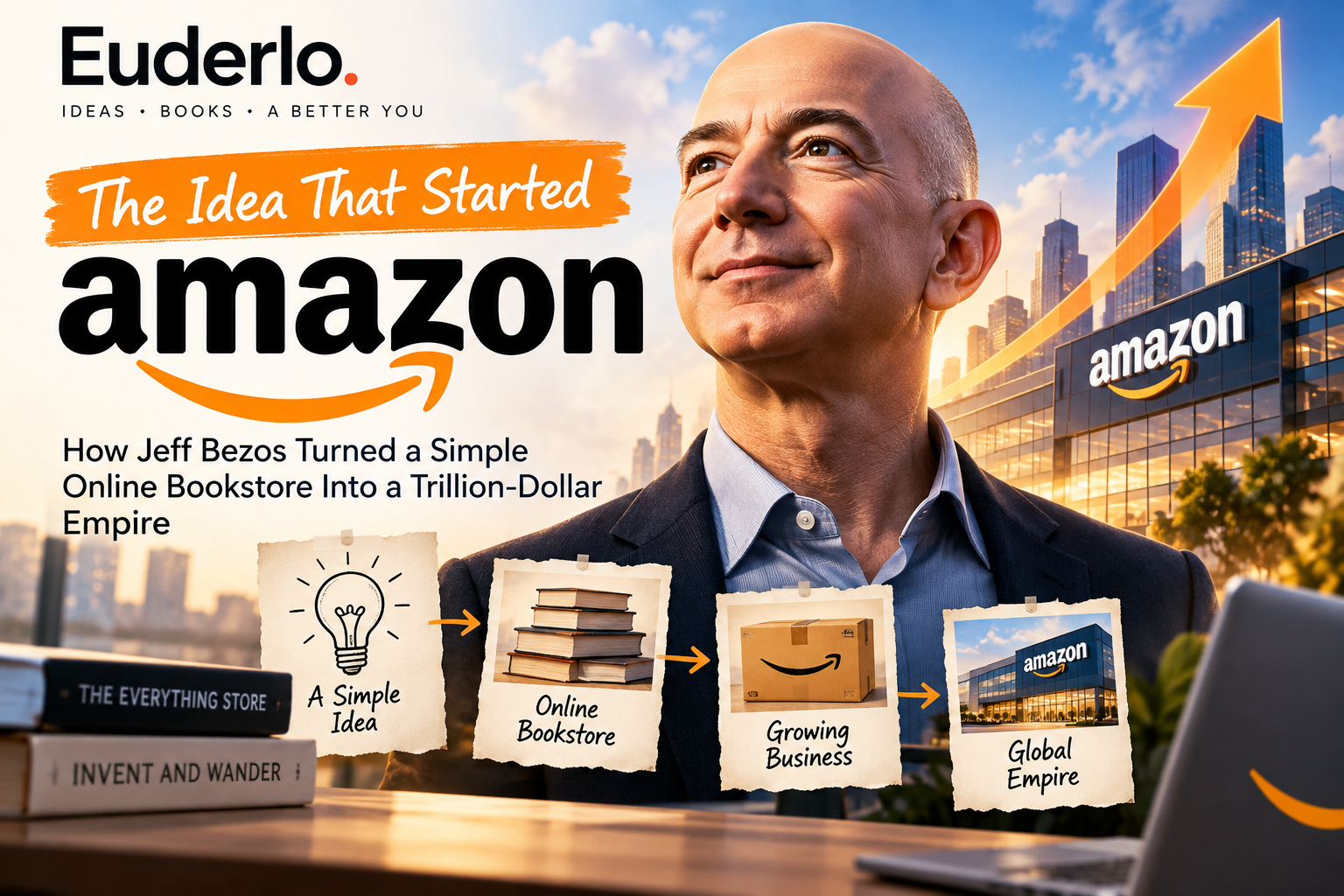
When we look at Amazon today, it is easy to imagine that the company must have started with an enormous plan: warehouses everywhere, millions of products, cloud computing, Prime memberships, artificial intelligence, logistics, devices, entertainment and one of the world's most powerful technology businesses. But that is not how the story began. The beginning was much smaller, and perhaps that is what makes the story worth remembering. In 1994, Jeff Bezos was working in New York at the investment firm D. E. Shaw when he became fascinated by the rapid growth of the internet. He began thinking about what could be built on this new technology, and one idea stood out: an online bookstore that could offer millions of titles, something a physical bookstore could never realistically hold. Bezos later explained that the concept for Amazon came to him in 1994 and that he eventually decided to leave his successful job because he did not want to reach old age wondering what might have happened if he had never tried.
I think this is where we should pause, because when we hear stories about billion-dollar companies, we often focus on the billion dollars and forget the uncertainty that existed before the first dollar was earned. Imagine having a good job, a career, a salary and a relatively comfortable future, and then deciding to walk away because you believe something that most people around you cannot yet see. Bezos has said that when he explained his decision to his boss, his boss advised him to think about it carefully because he already had a good job. Bezos did think about it, but he eventually chose what he called a “regret minimisation framework”: he imagined himself at around 80 years old and asked which decision would leave him with fewer regrets. His concern was not that the startup would certainly succeed; it was that he might regret never trying to participate in what he believed could become an important new technology.
The first Amazon was not the Amazon we know
When Bezos started the company in 1994, the idea was not “build everything". It was much more focused. He wanted to use the internet to create an online bookshop with an enormous selection. The company was initially incorporated as Cadabra before becoming Amazon, and the public Amazon website launched in July 1995. The important lesson here is that we sometimes make our own ideas unnecessarily complicated. We think the first version needs to contain the final vision, but Amazon's early version did not need to sell everything. It needed to prove that people were willing to buy books online. That was the first step.
And books were actually a clever starting point because the physical world had an obvious limitation: no normal bookstore could stock every book ever published. Bezos saw an opportunity to use the internet to remove some of that physical limitation. In Amazon's original 1997 shareholder letter, Bezos explained that the company wanted to give customers much more selection than a physical store could provide and make the store searchable, easy to browse and available 24 hours a day, 365 days a year. That is a powerful way to think about business ideas: instead of asking, “What product should I sell?”, ask, “What limitation do people currently accept because nobody has solved it well?”
The garage was not the real story
We often romanticize the garage. We imagine a founder sitting alone with a laptop, writing code while dreaming about becoming a billionaire. But the more interesting part of Amazon's beginning was not the garage; it was the willingness to enter an uncertain market before the outcome was obvious. Bezos himself has said that his parents invested a large portion of their savings in Amazon's early stage, even though he told them he believed there was a significant chance they could lose their investment. He also said it took more than 50 meetings to raise $1 million from investors, and one of the recurring questions he encountered was essentially, “What is the internet?” Imagine hearing that question while trying to convince someone that the internet could change commerce. Today, the idea sounds obvious. Back then, it was anything but obvious.
That is something I want us to remember whenever we have an idea that other people do not understand. Sometimes an idea is genuinely bad, and sometimes the world simply has not developed enough context to understand it yet. We should not automatically assume that criticism means we are right, but we also should not automatically assume that criticism means we are wrong. The better question is: Can we test the idea? Can we create something small? Can real people use it? Can we learn from what happens next?
Bezos did not build Amazon by predicting everything
One of the biggest misunderstandings about entrepreneurship is the belief that successful founders see the entire future. Amazon's history tells us something different. In 1997, Amazon was primarily an online bookseller. Yet Bezos wrote about a much larger opportunity in online commerce and emphasized the importance of thinking long term. Amazon's sales had grown from $15.7 million in 1996 to $147.8 million in 1997, while cumulative customer accounts grew from 180,000 to 1.51 million. Those numbers show that the company was growing rapidly, but they also show something else: the giant company we know today was built through stages.
Prime did not exist in 1997. Marketplace did not exist in its modern form. Alexa did not exist. AWS did not exist. Amazon itself later pointed out that these were not predetermined parts of the original company; they were ideas developed later through experimentation, investment and risk-taking. This matters because when we think about our own future, we may believe that we need to know exactly what our company will become ten or twenty years from now. We don't. We need a meaningful direction, a real problem to solve and the willingness to keep learning.
The most important Amazon idea was not books
If you ask me what the deeper idea behind Amazon was, I would not say books. I would say customer value. Books were the starting vehicle. The deeper philosophy was to make buying easier, give people more selection, improve convenience and continue experimenting with ways to serve customers better. Amazon's 1997 shareholder letter repeatedly emphasised customer focus, better selection, lower prices, useful search and improving the shopping experience.
This is one of the biggest lessons we can take from the Amazon story. A product can change. A market can change. Technology can change. Your first business model can change. But if you understand the underlying problem you are solving, you have something much more durable. Amazon started with books, but the underlying question became much larger: How can the internet help people discover, choose and receive what they need more easily?
From bookstore to everything
Once Amazon had built infrastructure, customers, technology and trust, the company could expand beyond books. That expansion was not simply about adding random products. It was about asking what else customers wanted and what capabilities the company could build. Over time, Amazon moved into broader retail, third-party sellers, Prime, logistics, devices, entertainment and cloud computing. The company later described Marketplace, Prime and AWS as major ideas that it continued to improve and nurture.
And this is where the story becomes much bigger than Amazon. If we study companies that become enormous, we often discover that the first product is only the doorway. The real company is the system that grows behind that product. A bookstore can become an e-commerce platform. An e-commerce platform can build logistics. Logistics can support faster delivery. Millions of customers can create demand for membership. Huge computing infrastructure can become a cloud business. A customer relationship can become an ecosystem. In other words, one successful capability can become the foundation for another opportunity.
The “Day 1” mindset
There is another idea from Amazon's history that I find particularly interesting: Day 1. In the original 1997 shareholder letter, Bezos described the internet as being at “Day 1” and argued that Amazon was still at the beginning of what could become a much larger opportunity. Amazon has continued to use the Day 1 idea for decades. Its later shareholder communications repeatedly returned to the core principle that the company should continue behaving like a startup: experimenting, learning, inventing and focusing on customers.
Think about what happens when we believe we have already made it. We become comfortable. We protect old decisions. We stop listening to customers. We become slower. We start defending what exists instead of creating what could exist. The Day 1 mindset asks us to remain curious even after success. It does not mean ignoring experience; it means refusing to let experience become an excuse for stopping.
What books can teach us about this story
If you want to understand the Amazon story beyond a simple success narrative, one of the most famous books to explore is The Everything Store: Jeff Bezos and the Age of Amazon by Brad Stone. It examines Amazon's development, Bezos's leadership style and the company's transformation from an online bookstore into a much larger technology and commerce business. Another useful book is Invent and Wander: The Collected Writings of Jeff Bezos, which brings together Bezos's shareholder letters and other writings and gives us a direct look at the principles Amazon emphasized over the years. These books are particularly useful because they help us move beyond the myth of “one brilliant idea” and see the combination of experimentation, customer focus, technology, capital, infrastructure and long-term thinking that shaped Amazon.
But I would add something important here: we should be careful with founder stories. A successful company can make its original decisions look inevitable when we look backward. They were not inevitable. Amazon faced competition, uncertainty, capital requirements and execution risks, and Bezos himself acknowledged those challenges in the company's early shareholder communications. Success does not prove that every decision was correct, and a famous founder's story should not become a formula that we blindly copy.
What I would take from Jeff Bezos's idea
If I were sitting with you and we were discussing this story over coffee, I would probably say that the most valuable lesson is surprisingly simple: start with a problem, not with the size of the empire you want to build. Bezos did not begin by saying, “I am going to build one of the world's largest companies.” He saw the rapid development of the internet, searched for a product category that made sense online, chose books, built the first version and learned from customers. Then the company kept expanding.
And maybe that is something you and I both need to remember when we think about our own ideas. We can dream about building a billion-dollar company, a trillion-dollar company or something that changes an entire industry, but the dream alone is almost worthless. The useful question is much smaller: What can I build today that solves a real problem for a real person? If the answer is strong, we can improve it. If people use it, we can expand it. If they come back, we can build trust. If the system works, we can scale it. And if we keep learning, perhaps the small idea can eventually become something far larger than we originally imagined.
The real Amazon lesson
The story of Amazon is therefore not simply a story about Jeff Bezos, money or a company that became extraordinarily valuable. It is a story about how an idea can evolve. A person noticed a technological shift. He asked what could be built on top of it. He chose one narrow starting point. He accepted uncertainty. He tested the idea. He listened to customers. He invested in infrastructure. He kept expanding the opportunity. And decades later, that original online bookshop had become a global business spanning commerce, cloud computing, logistics, advertising, devices and other businesses. Amazon's own shareholder communications show how much of that expansion came from ideas that did not even exist when the company began.
So when you have an idea that feels too small, don't dismiss it because it is small. Amazon's first idea was small enough to explain in a sentence: sell books online. The important part was not the size of the first sentence. It was what happened after that sentence. A great idea gives you a starting point; execution gives it a life; learning gives it direction; and time reveals how far it can travel.
The question I would leave you with is this: What is the small idea sitting in your mind today that you keep postponing because you cannot yet see how it becomes something big? Maybe it will fail. Maybe it will change completely. Maybe it will become something you never expected. But if it solves a real problem and you are willing to test, learn and improve it, you have at least given the idea a chance to become more than an idea.
Amazon — The Company Behind the Idea
| Category | Amazon |
|---|---|
| Company name | Amazon.com, Inc. |
| Founded | 1994 |
| Online store launched | July 1995 |
| Founder | Jeff Bezos |
| Original idea | An online bookstore |
| Original opportunity | The rapidly growing internet and the possibility of selling books online |
| Original headquarters | Seattle, Washington |
| Corporate incorporation | Amazon was incorporated in Washington in 1994 and reincorporated in Delaware in 1996 |
| IPO | May 15, 1997 |
| Original IPO price | $18 per share, before subsequent stock splits |
| Current CEO | Andy Jassy |
| Current Executive Chair | Jeff Bezos |
| Ticker | AMZN |
| Stock exchange | Nasdaq Global Select Market |
| Mission | To be Earth’s most customer-centric company |
| Core customers | Consumers, sellers, developers, enterprises, content creators, advertisers, and employees |
| Main operating segments | North America, International, and Amazon Web Services (AWS) |
| Major business areas | E-commerce, third-party marketplace, cloud computing, advertising, subscriptions, entertainment, devices, publishing, logistics, groceries and emerging technologies |
| 2025 revenue | Approximately $717 billion |
| 2025 operating income | Approximately $80 billion |
| 2025 AWS revenue | Approximately $129 billion |
| 2025 North America revenue | Approximately $426 billion |
| 2025 International revenue | Approximately $162 billion |
| Current strategic focus | Customer experience, long-term growth, AI, cloud computing, logistics, advertising, digital entertainment, robotics and emerging technologies |
| Company philosophy | Customer obsession, invention, operational excellence and long-term thinking |
| Stage | What happened |
|---|---|
| 1994 | Jeff Bezos founded Amazon. |
| Initial thinking | Bezos was interested in the rapidly expanding possibilities of the internet. |
| Starting category | Books were selected as the initial product category. |
| Why books? | An online store could potentially offer a much larger selection than a physical bookstore. |
| 1995 | Amazon opened its online store to customers. |
| Early identity | Amazon operated primarily as an online bookseller. |
| 1997 | Amazon became a publicly traded company. |
| Next phase | Amazon expanded beyond books into additional product categories. |
| Marketplace evolution | Third-party sellers became an important part of Amazon's commerce model. |
| AWS | Amazon developed cloud infrastructure into Amazon Web Services, creating a major technology business alongside retail. |
| Prime | Amazon developed a subscription ecosystem around delivery and later expanded it into entertainment and other benefits. |
| Devices & media | Kindle, Fire, Echo, Alexa and other products expanded Amazon beyond conventional online retail. |
| Advertising | Amazon developed a significant advertising business connected to its commerce ecosystem. |
| Today | Amazon operates across retail, cloud computing, advertising, entertainment, devices, logistics, subscriptions and other businesses. |
| Business | What it does | How it fits Amazon |
|---|---|---|
| Amazon Stores | Online and physical retail | Core consumer-commerce business |
| Third-Party Marketplace | Allows independent sellers to sell products | Expands selection beyond products Amazon sells directly |
| Amazon Prime | Subscription service with delivery, entertainment and other benefits | Builds recurring customer relationships |
| AWS | Cloud computing, storage, databases, AI and other infrastructure services | Major enterprise technology business |
| Amazon Advertising | Advertising products for brands and sellers | Monetizes Amazon's shopping ecosystem |
| Prime Video | Video streaming and entertainment | Part of Amazon's subscription ecosystem |
| Amazon Music | Music streaming | Digital entertainment |
| Kindle | Digital reading devices and ecosystem | Connects Amazon with books and publishing |
| Kindle Direct Publishing | Self-publishing platform | Enables authors to publish directly |
| Amazon Devices | Kindle, Fire, Echo and related devices | Hardware + digital ecosystem |
| Alexa | Voice assistant technology | Connects customers with Amazon services and devices |
| Amazon Logistics | Delivery and fulfillment infrastructure | Supports Amazon's commerce network |
| Fulfillment by Amazon | Storage, fulfillment and delivery services for sellers | Connects marketplace sellers with Amazon infrastructure |
| Amazon Fresh / Grocery | Grocery-related shopping and delivery | Expands Amazon into everyday consumer purchases |
| Amazon Pharmacy | Pharmacy services | Extends Amazon into healthcare-related commerce |
| Zoox | Autonomous-driving technology | Emerging technology business |
| Amazon Leo | Satellite-based connectivity initiative | Emerging connectivity business |
| Robotics | Warehouse and logistics automation | Supports operational efficiency and fulfillment |
Amazon's 16 Leadership Principles
| # | Leadership Principle | What it means |
|---|---|---|
| 1 | Customer Obsession | Start with the customer and work backward from their needs. |
| 2 | Ownership | Think and act like an owner, including thinking long term. |
| 3 | Invent and Simplify | Create new solutions while making things simpler. |
| 4 | Are Right, A Lot | Develop strong judgment while actively seeking different perspectives. |
| 5 | Learn and Be Curious | Keep learning and explore new possibilities. |
| 6 | Hire and Develop the Best | Build strong teams and help people develop. |
| 7 | Insist on the Highest Standards | Continually raise quality expectations. |
| 8 | Think Big | Build ambitious visions and look beyond immediate possibilities. |
| 9 | Bias for Action | Move quickly and take calculated risks where appropriate. |
| 10 | Frugality | Accomplish more with fewer resources. |
| 11 | Earn Trust | Listen, communicate candidly and treat people respectfully. |
| 12 | Dive Deep | Understand details and investigate the underlying facts. |
| 13 | Have Backbone; Disagree and Commit | Challenge decisions respectfully, then commit once a decision is made. |
| 14 | Deliver Results | Focus on important outcomes and execute effectively. |
| 15 | Strive to be Earth's Best Employer | Work toward a safer, productive and supportive workplace. |
| 16 | Success and Scale Bring Broad Responsibility | Recognize the wider effects of operating at Amazon's scale. |
| Principle | Amazon's approach |
|---|---|
| Customer obsession | Focus on customer needs rather than simply copying competitors. |
| Passion for invention | Continually create new products, services and ways of working. |
| Operational excellence | Build systems and processes that can operate at enormous scale. |
| Long-term thinking | Make decisions based on durable value rather than only immediate results. |
| Period | Amazon's identity |
|---|---|
| 1994–1995 | Internet startup / online bookstore |
| 1997 | Publicly traded online retailer |
| Late 1990s | Expanding online retailer |
| 2000s | Broad e-commerce platform and marketplace |
| 2005 onward | Subscription ecosystem through Prime |
| 2006 onward | Major cloud-computing company through AWS |
| 2010s | Commerce + cloud + devices + entertainment + advertising |
| 2020s | Global technology, commerce, cloud, advertising, entertainment and logistics company |
| 2025 | $717 billion annual revenue, with AWS alone generating about $129 billion |
| Person | Role | Period / status |
|---|---|---|
| Jeff Bezos | Founder | Founded Amazon in 1994 |
| Jeff Bezos | CEO | Served as CEO until 2021 |
| Jeff Bezos | Executive Chair | Current role |
| Andy Jassy | CEO | Became CEO in July 2021 |
| Andy Jassy | Earlier Amazon role | Led AWS before becoming CEO |