Imagine Having an AI Assistant You Never Have to Open
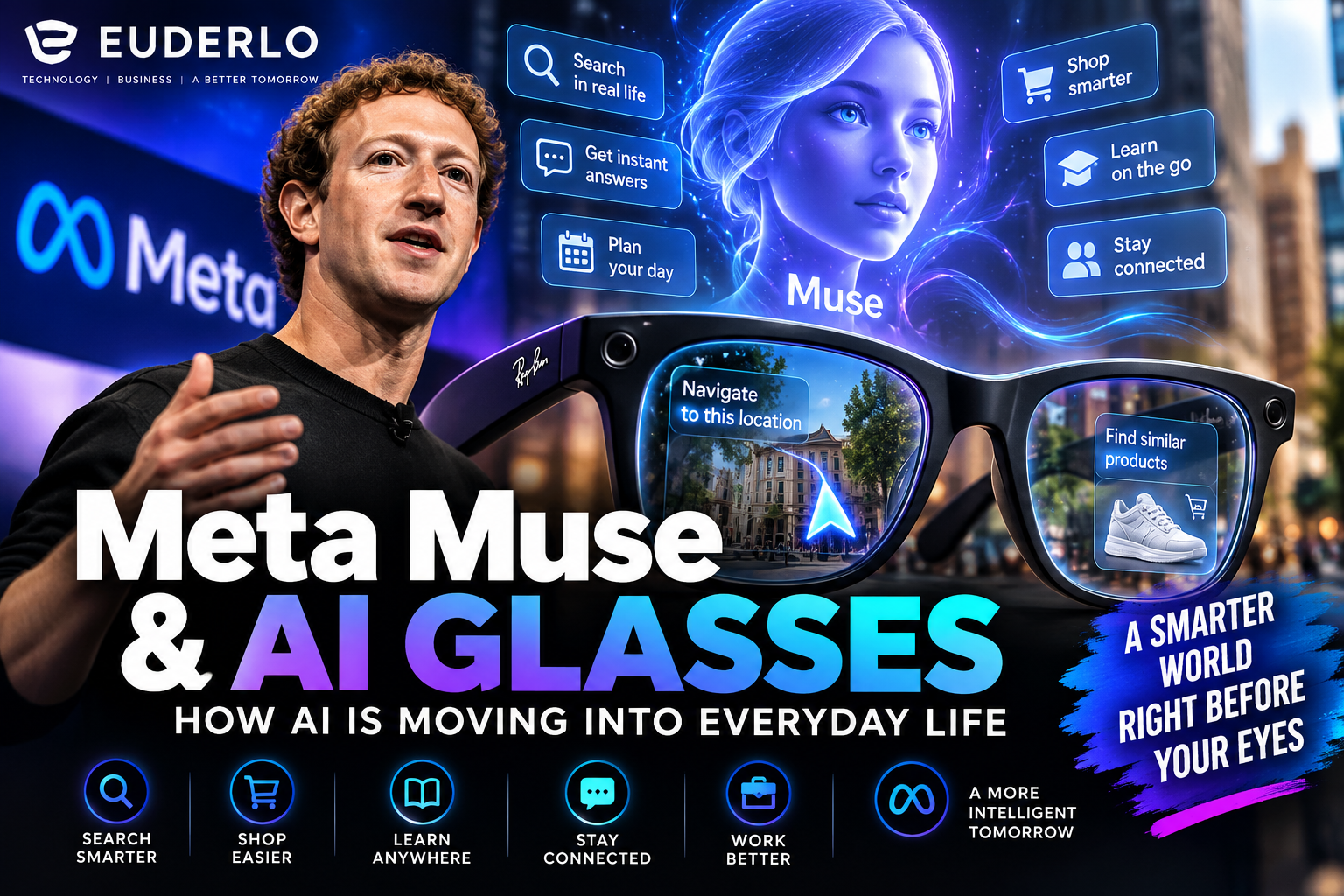
Imagine walking down a street and seeing a restaurant you have never heard of. Instead of taking out your phone and searching for it, you simply ask, “What is this place?” Imagine reading a sign in another language and asking for a translation without touching your phone. Imagine looking at a product in a store and asking whether it is worth considering, or seeing something interesting while travelling and asking your AI assistant to remember it for later. This is the idea behind the next generation of AI glasses, and Meta is moving aggressively in that direction. In September 2026, Meta introduced Muse, its personal AI agent, and announced that Muse is coming to its AI glasses. Meta's vision is not simply to put another chatbot inside a pair of glasses. It is to create an AI assistant that can understand more of what you are seeing and hearing while helping you perform tasks throughout your day. Meta — Introducing Muse That is why Meta Muse AI, Meta AI glasses 2026, AI glasses, smart glasses with AI and AI personal assistant are becoming important technology topics. The real question is not whether glasses can become smarter. They already are. The more interesting question is what happens when artificial intelligence stops waiting for us to open it and starts becoming part of the environment around us.
What Is Meta Muse?
Meta Muse is Meta's new personal AI agent, announced in September 2026. The word “agent” matters because Meta is trying to move beyond the traditional chatbot model. A chatbot generally waits for you to ask something and then gives you an answer. An AI agent is designed to take a goal and perform multiple steps to help you accomplish it. Meta says Muse can help with tasks including planning activities, sending emails, browsing the web, booking travel and making purchases, while some longer-running tasks can continue in the background. Meta has also described a dedicated environment called Muse Secure VM, designed to isolate the agent and protect connected data and credentials. Meta — Introducing Muse: The World's First Personal AI Agent In simple terms, Meta Muse is trying to become an assistant that can do more than talk. Instead of asking, “How do I book a trip?” you could eventually give an AI the goal of helping you organize one. Instead of asking, “How do I compare these products?” you could potentially ask it to compare them for you. This is the larger movement toward agentic AI, where AI systems are increasingly designed to perform tasks rather than simply generate responses.
Why Is Meta Putting Muse Into AI Glasses?
This is where the story becomes much more interesting. Meta says Muse is coming to its AI glasses so users can access their personal AI while going about their everyday lives. At Connect 2026, Meta demonstrated interactions in which Muse can work with what the wearer is looking at, such as a product on a shelf, a flyer or a list. Meta — The Biggest News From Connect 2026 Think about what this means from a normal person's perspective. Today, if you want AI to understand something you are looking at, you usually need to take out your phone, take a picture or type a description. AI glasses can potentially shorten that process. You look at something and ask about it. The camera provides visual information, the microphones capture your question, the AI interprets the situation and the assistant responds. This is why the future of AI glasses 2026 is not simply about better cameras or better speakers. It is about giving AI access to more context without forcing humans to constantly stop what they are doing.
How Do Meta AI Glasses Work?
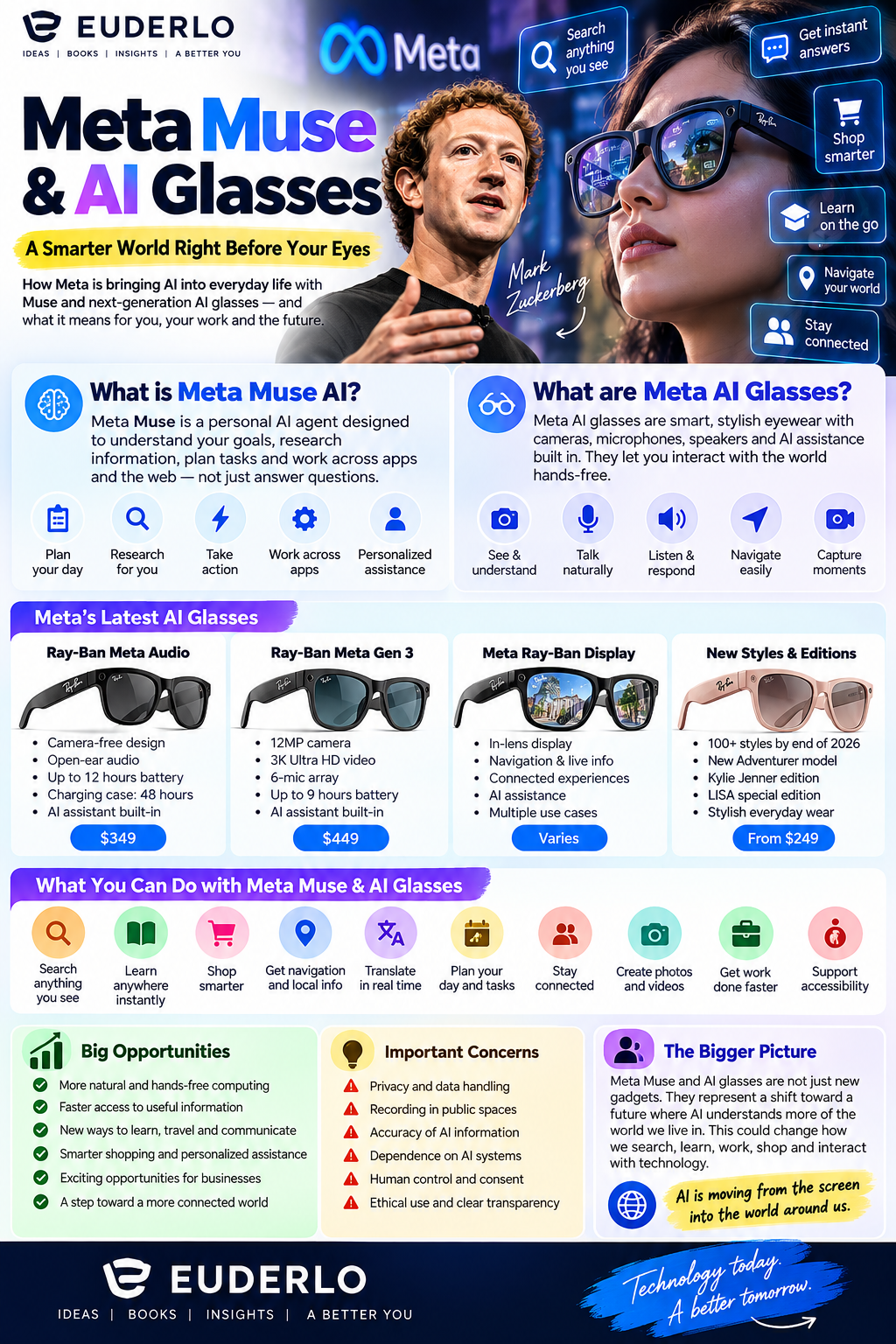
At a basic level, Meta's AI glasses combine cameras, microphones, speakers, wireless connectivity and artificial intelligence into a wearable form. The camera can capture visual information, microphones allow the user to communicate with the assistant, speakers provide audio responses and the connected AI services process requests. The important difference between ordinary glasses and AI glasses is that the device becomes an interface between the wearer and digital information. Meta's latest hardware continues to improve these components. The company says its new Ray-Ban Meta Gen 3 includes a 12MP camera, 3K Ultra HD video recording, six microphones, a customizable action button and up to nine hours of battery life. Meta — Ray-Ban Meta Gen 3 These specifications are important, but the real value comes from what they allow the AI to understand and how naturally the user can interact with it. The goal is for technology to feel less like operating a computer and more like having a conversation with an assistant.
What Can Meta Muse Do?
Meta says Muse can help users with a range of tasks, including planning, web browsing, email, travel and purchases. Meta is also building connections between Muse and external services, which makes the agent more useful because it can potentially operate across multiple parts of a person's digital life. Meta announced integrations involving retailers and services such as Walmart, Best Buy, Sephora, Ulta, Wayfair and Gap, as well as Shop Pay and PayPal, while Expedia, Instacart, Notion, GitHub and Box are also part of the broader integration strategy. Meta — Muse and Connect 2026 This is an important difference between an AI that only answers questions and an AI agent that can interact with services. If the technology develops as Meta intends, people may increasingly tell AI what they want rather than manually opening several applications to complete every part of a task.
Why AI Agents Are Different From Chatbots
The difference between a chatbot and an AI agent may sound technical, but it can affect how we use technology every day. Suppose you ask a chatbot, “What should I take on a three-day trip to Delhi?” It might give you a useful packing list. An agent could potentially go further by understanding your dates, checking relevant information, organizing a plan and helping you complete associated tasks. The important transition is from information to action. Chatbots primarily made it easier to access information. AI agents are attempting to make it easier to accomplish goals. This is why agentic AI, AI agents, personal AI assistants and AI automation are becoming such important search topics in 2026. The technology is still developing, and capabilities vary between products, but the direction is clear: companies increasingly want AI systems to become useful workers rather than simply conversational interfaces.
Is Meta Trying to Replace Your Smartphone?
Probably not in the immediate future, and there is no evidence that Meta's current AI glasses are about completely replacing smartphones. Smartphones remain better for many activities that require a large screen, detailed editing, long reading sessions, complex applications or intensive typing. The more realistic possibility is that AI glasses could make some smartphone interactions unnecessary. You may not need to unlock your phone for a quick question. You may not need to hold it while navigating. You may not need to take it out every time you want to capture a moment or ask for information. In this sense, the future of smart glasses is not necessarily “glasses instead of phones.” It may be “glasses for the moments when reaching for your phone feels unnecessary.” That distinction matters because successful technology often does not completely destroy the previous product; it changes when and why people use it.
The AI Glasses Market Is Already Growing
One reason this story deserves attention is that Meta is not building this market from zero. Its partnership with EssilorLuxottica has already created a substantial consumer business around Ray-Ban Meta and Oakley Meta glasses. EssilorLuxottica reported that its AI glasses sold more than 7 million units in 2025, showing that consumers are already buying wearable products that combine traditional eyewear with technology. EssilorLuxottica — 2025 Full-Year Results The company also reported in its first-half 2026 results that AI-glasses revenue was almost doubling year over year in the second quarter. EssilorLuxottica — H1 2026 Results Those figures do not prove that everyone will soon wear AI glasses, but they do show that the category has already become a meaningful commercial market.
Why Ray-Ban Matters to Meta
There is a simple reason Meta's partnership with Ray-Ban is strategically important: people already want to wear Ray-Ban. Meta does not have to convince consumers that a futuristic-looking computer should sit on their face. It can put technology inside a familiar fashion product. This makes the product feel less like a computer and more like something people already use. That is an underrated lesson in product design. The best technology is not always the technology that looks the most futuristic. Sometimes it is the technology that hides its complexity behind something familiar. Meta can improve the AI, camera, battery and audio experience while the customer continues to experience the product as a pair of glasses.
What Is Ray-Ban Meta Gen 3?
The Ray-Ban Meta Gen 3 is Meta's latest generation of its AI glasses. Meta says the product starts at $449 in the United States and includes a 12MP camera, 3K Ultra HD video, a six-microphone system and up to nine hours of battery life. Meta also says the microphones can reduce more than 90% of background noise. Meta — Introducing Ray-Ban Meta Gen 3 For ordinary users, these specifications matter because wearable AI has one major challenge: everything has to work inside a very small device. A powerful AI assistant is not very useful if the microphone cannot understand you in a noisy street, the battery dies quickly or the glasses are uncomfortable. This means the future of AI wearables will depend on both software and hardware improving together.
What Are Ray-Ban Meta Audio Glasses?
Meta has also introduced Ray-Ban Meta Audio, a camera-free version of its wearable strategy. Meta says the glasses focus on audio, calls and AI interaction, weigh 43 grams and offer up to 12 hours of use, with additional battery capacity through the charging case. The starting US price is $349. Meta — Ray-Ban Meta Audio This is an interesting move because not everyone is comfortable with the idea of wearing a camera. By offering an audio-only option, Meta can appeal to people who want hands-free AI and audio without wanting visual recording capabilities. It also demonstrates something important about consumer technology: privacy concerns can influence product design. The future of wearable AI will probably not involve one device that everyone uses in exactly the same way. There will likely be different products for different comfort levels and use cases.
What Can AI Glasses Actually Help You With?
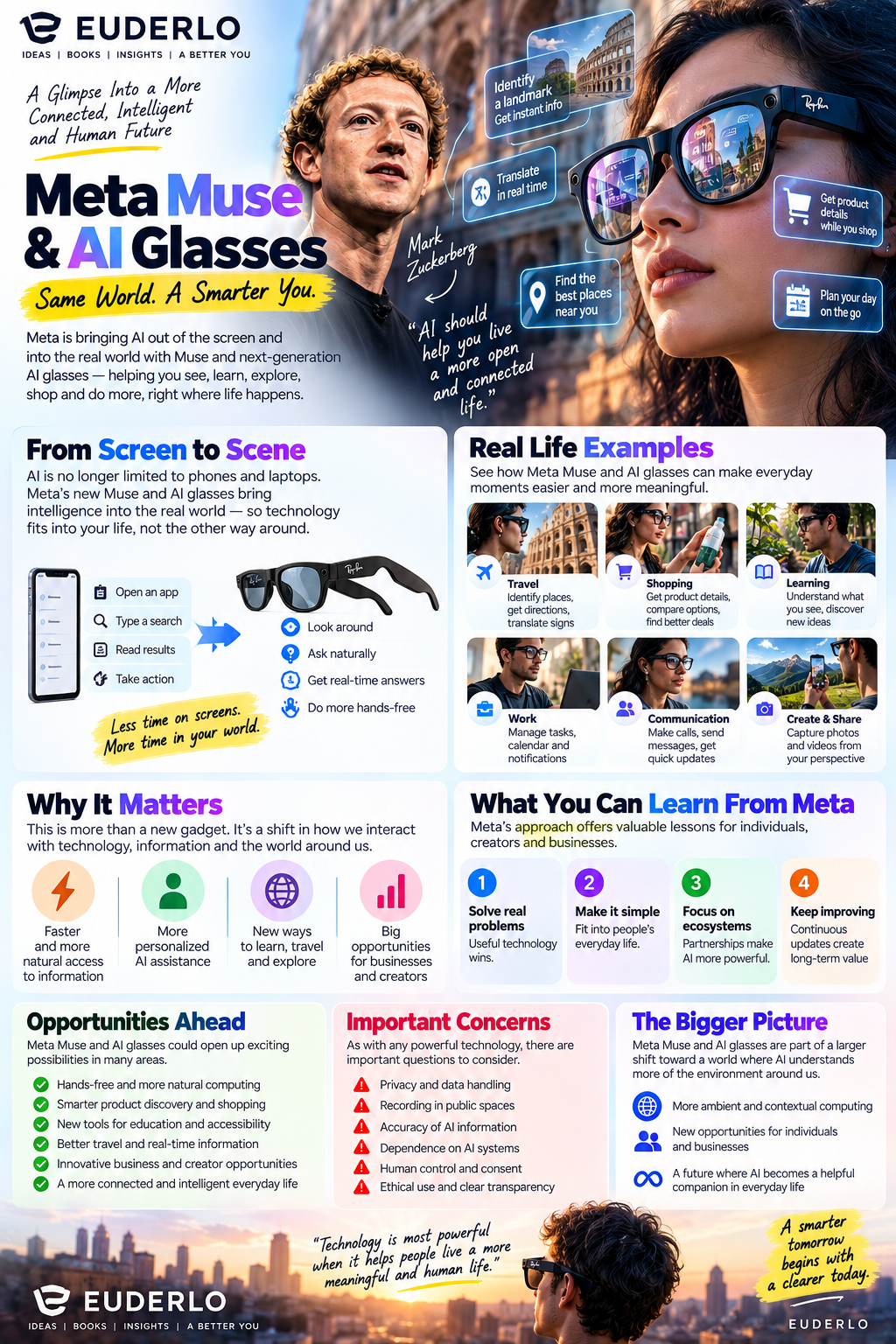
The most useful way to understand AI glasses is to forget the technology for a moment and think about everyday problems. You could imagine using them for quick questions while walking, hands-free communication, translation, navigation, photography, identifying objects, understanding information in front of you or getting help with everyday decisions. Some of these experiences are already available in different forms, while others represent the broader direction of multimodal AI rather than confirmed Muse capabilities. The important idea is that AI becomes available in context. Instead of taking a picture and then explaining why you took it, the system can potentially understand the thing you are looking at while you are already talking about it. This is one of the most interesting possibilities of multimodal AI.
How AI Glasses Could Change Travel
Travel is one of the easiest areas in which to imagine the usefulness of AI glasses. Think about arriving in a country where you do not speak the language. You see a sign, menu or public-transport notice and want to understand it. Today, your phone becomes the bridge between you and that information. In the future, wearable AI could make that bridge more natural by allowing you to ask for help while continuing to look at the world. Navigation could also become more hands-free, particularly as Meta develops display-based glasses capable of providing visual information. Meta has announced features involving navigation and landmark-based directions for its Meta Ray-Ban Display. Meta — New Features for Meta Ray-Ban Display This could eventually make travel less about staring at a map and more about interacting with the environment around you.
How AI Glasses Could Change Shopping
Shopping may be one of the biggest areas of change. Imagine walking through a store and seeing a product you are considering buying. Instead of opening a search engine, you could ask your AI assistant to explain what it is or help compare it with something else. If AI agents can connect with retailers and payment systems, shopping could become increasingly conversational. Meta is already building integrations with major retailers and payment providers as part of Muse's ecosystem. Meta — Muse Commerce and Connectors The future shopping experience could therefore shift from “search, click, compare and purchase” toward “tell the AI what you need, review its recommendation and approve the purchase.” That is the basic idea behind agentic commerce.
Could AI Agents Change Online Shopping Forever?
Potentially, but there are major questions still being worked out. If an AI agent represents the customer, the traditional website may become less important as the place where the customer makes decisions. The AI could become the intermediary that compares multiple businesses. This could be powerful for consumers but complicated for companies because businesses may want control over how their websites and products are accessed. Recent reporting around Meta Muse and Amazon illustrates this tension, with Amazon objecting to aspects of Muse's interaction with Amazon's shopping environment. Reuters — Meta Muse and the AI-agent commerce debate This is one of the most important business stories around AI agents because it shows that the future will not be determined only by what AI can technically do. It will also depend on what companies allow AI agents to access.
What Does Meta Muse Mean for SEO?
This is where the story becomes particularly important for website owners. Traditional SEO has focused heavily on getting a page to appear in search results. But if users increasingly ask AI agents for recommendations, businesses may need to think about whether AI can understand their information. Imagine someone asking, “Find me a good cleaning service in Delhi available tomorrow for under ₹1,000.” The AI may need information about service areas, pricing, reviews, availability and the actual services offered. A website with unclear information becomes harder to recommend. This does not mean traditional Google SEO is dead. It means businesses may need to optimize for a wider ecosystem that includes search engines, AI systems, social platforms and recommendation engines. This is why AI SEO, AI search optimization, Generative Engine Optimization and GEO are becoming important topics for digital marketers.
Will Keywords Still Matter in the AI Era?
Yes, but keywords should be used naturally rather than treated as the entire strategy. Search engines and AI systems still need language and context to understand a page. The difference is that simply repeating a phrase such as “best AI glasses 2026” twenty times does not create useful information. A stronger page would explain what AI glasses are, how they work, which products exist, what they cost, what users can do with them, what the limitations are, how privacy works and what the future could look like. That creates semantic depth around the topic. For Euderlo, this means naturally covering related searches such as what is Meta Muse, how Meta Muse works, Meta AI glasses features, Ray-Ban Meta Gen 3, AI glasses privacy, future of AI glasses, AI agents, agentic commerce and future of wearable technology while actually answering the questions readers have.
Why This Could Be the Next Big Change in Search
Search began with short keywords such as “hotels Delhi” or “best phone.” Then people began writing longer questions. AI assistants have pushed the process even further by allowing people to describe an entire goal in one sentence. Instead of searching for “Delhi hotel metro,” someone can ask, “Find me a quiet hotel in Delhi for Friday under ₹5,000, close to a metro station and suitable for a one-night stay.” That is no longer just a keyword search. It is a request for a decision. AI agents are increasingly designed to respond to these kinds of requests. This means businesses may eventually compete not only for search rankings but for AI recommendations. Being understood, trusted and relevant could become as important as being visible.
What Does This Mean for Small Businesses?
The lesson for small businesses is surprisingly simple. You do not need to build AI glasses. You need to remove unnecessary effort from your customer's journey. If customers repeatedly ask the same questions, make those answers easy to find. If booking requires too many steps, simplify it. If customers do not understand your pricing, explain it clearly. If your website does not explain exactly what you offer, improve the information. If your business information is inconsistent across platforms, fix it. AI may eventually become another way customers discover businesses, but the fundamental requirement will remain the same: your business needs to be understandable. An AI cannot confidently recommend something it cannot clearly understand.
What Can Entrepreneurs Learn From Meta?
Meta's strategy offers several useful lessons for entrepreneurs. The first is to reduce friction rather than simply adding features. The second is to put technology into places where people already behave naturally. The third is to build an ecosystem instead of thinking about one isolated product. The fourth is to create habits because repeated use can be more valuable than occasional use. The fifth is to make complicated technology feel simple. The sixth is to think about distribution at the same time as product development. The seventh is to build trust into the product from the beginning. And the eighth is to watch changes in user behaviour because the biggest opportunities often appear when the way people interact with technology changes.
Why Meta's Distribution Strategy Matters
Meta's biggest advantage may not actually be its glasses. It may be the ecosystem surrounding them. Meta operates Facebook, Instagram, WhatsApp and Messenger while simultaneously developing AI models, AI assistants and wearable devices. That means Meta can potentially introduce AI into environments where hundreds of millions or billions of people already spend time. This is an important lesson for startups: great technology is not enough without distribution. A company can build an excellent product and still struggle if customers never discover it. Meta is attempting to connect its AI, social platforms, commerce systems and hardware into one broader ecosystem. Meta — Connect 2026
Why Privacy Is One of the Biggest Questions Around AI Glasses
The more useful AI glasses become, the more important privacy becomes. A phone usually sits in your hand or pocket. Glasses can remain on your face while you walk through public places. That creates difficult questions about recording, data processing and people nearby. Meta says its AI glasses use a visible capture LED to indicate when photos or videos are being captured and says that disabling the LED also disables the camera. Meta — Meta's AI Glasses: Your Questions Answered Meta has also described permission controls for Muse and confirmation for sensitive actions. But the broader debate is much larger than one company's controls. Users will increasingly want to know what AI can see, what it remembers, where information goes, which applications it can access and what actions it can take. Reuters has also reported on the privacy concerns facing AI-powered wearables as companies attempt to bring these devices into everyday life. Reuters — Privacy Challenges for AI Wearables
Could Privacy Become a Competitive Advantage?
It could. When technology becomes more powerful, people often want more control rather than less. An AI assistant that can remember information, interact with services and potentially make purchases needs clear boundaries. Meta says Muse requires confirmation for sensitive actions and provides users with controls over connected services. Meta — Muse Privacy and Security For consumers, these controls may eventually become as important as battery life and camera quality. A product that clearly communicates what it is doing can potentially build more trust than a product that hides its behaviour. The future of AI therefore depends not only on intelligence but also on permission, transparency and control.
What Could AI Glasses Mean for Students and Learning?
The educational possibilities are fascinating. Imagine a student reading something difficult and asking an AI assistant for a simpler explanation. Imagine learning a language while travelling and receiving translations through a wearable device. Imagine visiting a historical site and asking for information about what you are seeing. Imagine someone learning a practical skill while keeping both hands free. These examples represent potential applications of multimodal AI rather than promises that every one is currently available through Meta Muse, but they demonstrate why the technology is interesting. AI glasses could eventually make learning more contextual because the AI can potentially connect information with what the learner is actually seeing and experiencing.
Could AI Glasses Change Work?
The workplace may eventually become one of the biggest markets for wearable AI. Technicians, engineers, field workers, warehouse employees, designers and other professionals often need information while keeping their hands busy. A smartphone is not always convenient in those situations. A wearable assistant could potentially provide instructions, translations, checklists, documentation or communication without requiring the worker to constantly stop and interact with a screen. This is why the long-term opportunity for AI wearable technology may extend well beyond consumer gadgets. It could eventually affect logistics, manufacturing, education, field services, accessibility and professional training.
What Does Meta Muse Mean for Content Creators?
Creators should pay attention because AI agents could change how audiences discover content. Today, someone searching for “books that can help me rebuild my life” might open Google and browse several articles. In an AI-driven future, the person could simply ask an AI assistant for recommendations based on their specific situation. This means creators need to think beyond keywords. Original ideas, first-hand experience, credible sources, strong explanations and clear authorship may become increasingly valuable. A creator who simply rewrites information available on hundreds of other websites has less to distinguish their work. A creator who adds genuine insight gives both humans and AI systems something more useful to work with.
What Euderlo Can Learn From Meta Muse
Euderlo can take an especially useful lesson from this development. The goal should not be to publish content simply because a keyword is popular. The goal should be to create pages that genuinely answer the questions people have. A book summary should tell the reader what the book teaches and how those lessons can be applied. A business article should explain not only what a company did but why the strategy matters. A technology article should distinguish confirmed information from future possibilities. Sources should be clearly linked. Authors should be identifiable. Important claims should be supported. This approach makes Euderlo more useful to readers today while also preparing the website for an internet in which AI increasingly helps people discover information.
Why the Future May Belong to Businesses That Remove Steps
Think about the most successful digital products. They often made something dramatically easier. Search engines made finding information easier. Messaging apps made communication easier. Digital payments made transactions easier. Food-delivery applications made ordering easier. AI agents are attempting to make decision-making and task completion easier. Meta Muse is part of that larger pattern. The product is not valuable because “AI” is written on the box. It becomes valuable when the customer can say, “This saved me time.” That is the business lesson entrepreneurs should remember. Technology is most powerful when people stop noticing the technology and start noticing the convenience.
Is Meta Actually Building the Future?
Nobody can say with certainty that Meta's current approach will become the dominant form of personal computing. AI glasses still face challenges around battery life, privacy, cost, comfort, social acceptance and usefulness. Other companies are developing competing AI assistants, wearable devices and agentic systems. Consumer habits can change quickly. A product can be technologically impressive and still fail to become a daily habit. Meta's announcements therefore show a direction rather than a guaranteed future. But the direction is significant: one of the world's largest technology companies is investing heavily in the idea that AI should become more personal, more contextual, more capable of taking action and more available through wearable devices.
The Biggest Change May Be the Way We Interact With Computers
For decades, we have adapted ourselves to computers. We learned keyboards, menus, buttons, apps and search queries. AI is reversing part of that relationship. Instead of learning exactly how software works, we increasingly tell the computer what we want in ordinary language. Instead of typing a description of an image, we can show it to AI. Instead of navigating multiple applications, we can ask an agent to help us complete a task. AI glasses take this one step further by potentially allowing the system to understand parts of the physical environment around us. This is why the real story behind Meta Muse and AI glasses is not the glasses themselves. It is the changing relationship between humans and computers.
The Future May Be Less About Opening AI and More About Living With It
Today, we open an AI application when we need help. Tomorrow, AI may be available throughout the day. Today, we search for products ourselves. Tomorrow, an AI agent may research options for us. Today, we look at our phones for directions. Tomorrow, wearable devices may provide information while we continue looking at the world. Today, we remember important information ourselves. Tomorrow, personal AI may help us remember it. This does not mean that humans will stop making decisions. In fact, the opposite may become more important. As AI becomes capable of taking more actions, humans will need to become better at deciding what they want AI to do and where they want it to stop.
The Final Lesson: AI Should Make Life Easier, Not Make Humans Less Free
The most interesting lesson from Meta Muse is not that everyone should buy AI glasses. It is that the next generation of technology is increasingly focused on reducing friction between people and information. The best AI will not necessarily be the one that produces the longest answers or has the most impressive technical specifications. It may be the AI that understands what you need, gives you useful information at the right moment and helps you complete a task without creating unnecessary work. But as AI becomes more capable, human control becomes more important too. We should decide what our AI can see, what it can remember, which services it can access and which actions require our approval. Meta Muse and AI glasses are therefore part of a much larger experiment: can artificial intelligence become useful enough to move with us while remaining trustworthy enough for us to live with it? We do not yet know the final answer. But one thing is becoming increasingly clear: AI is no longer staying inside the screen. It is beginning to move into the world around us.Meta Muse & AI Glasses — Quick Facts
| Detail | What it means |
|---|---|
| Technology | Meta Muse + AI-powered glasses |
| Main idea | Move AI assistance from the phone into the user's everyday environment |
| Meta Muse | Personal AI agent designed to perform tasks rather than only answer questions |
| AI glasses | Wearable devices combining AI with cameras, microphones, speakers and connectivity |
| Key interaction | Hands-free voice interaction and contextual assistance |
| Potential uses | Search, planning, learning, shopping, navigation, communication and everyday tasks |
| Agentic AI | AI that can work toward a goal and perform multiple steps |
| Ambient computing | Computing that becomes available through the environment instead of requiring constant screen interaction |
| Business significance | Could change product discovery, search, shopping and customer interaction |
| Major concern | Privacy, data handling, accuracy and human control |
| Feature | Traditional AI chatbot | Meta Muse |
|---|---|---|
| Main purpose | Answer questions | Help accomplish tasks |
| Interaction | Text or voice | Designed for broader task-based interaction |
| Research | Can provide information | Can potentially research as part of a task |
| Planning | Gives suggestions | Designed to turn goals into action plans |
| Web interaction | Usually conversational | Can work through a browser in its secure environment |
| Apps | Depends on integrations | Designed to work across connected apps |
| Personalization | Conversation-based | Meta says Muse can learn from conversations and what matters to the user |
| Wearable connection | Usually separate | Meta is bringing Muse to AI glasses |
| Human involvement | User performs most actions | AI can potentially handle more steps |
| Key question | “What should I know?” | “Can you help me get this done?” |
| Product | Important details | Starting price* |
|---|---|---|
| Ray-Ban Meta Audio | Camera-free, 43g, open-ear audio, AI assistant, up to 12 hours on a charge | $349 |
| Ray-Ban Meta Gen 3 | 12MP camera, 3K Ultra HD video, six-mic array, up to 9 hours battery | $449 |
| Meta Glasses | Expanded collection with additional styles and configurations | From $249 for a limited/new accessible model |
| Meta Glasses by Kylie Jenner | New Ivory colorway | From $399 |
| Meta Glasses LISA Edition | Two special-edition styles | From $399 |
| Meta Ray-Ban Display | In-lens display, navigation and additional connected experiences | Varies |
Ray-Ban Meta Gen 3 vs Ray-Ban Meta Audio
| Feature | Ray-Ban Meta Gen 3 | Ray-Ban Meta Audio |
|---|---|---|
| Camera | Yes | No |
| AI | Yes | Yes |
| Camera recording | Yes | No |
| Weight | Not specified by Meta in the announcement | 43g |
| Battery | Up to 9 hours | Up to 12 hours |
| Charging case | — | Up to 48 additional hours |
| Microphones | 6-mic array | Voice/call-focused audio system |
| Video | 3K Ultra HD | Not applicable |
| Background-noise reduction | More than 90%, according to Meta | Designed for clear calls |
| Starting price | $449 | $349 |
| Main concept | Camera + AI + audio | Audio + AI without camera |
What Can AI Glasses Potentially Help With?
| Area | Possible experience |
|---|---|
| Search | Ask about something you're seeing or hearing |
| Learning | Get explanations while exploring the real world |
| Travel | Navigation, translation and local information |
| Shopping | Product discovery and comparison assistance |
| Communication | Calls, messages and hands-free interaction |
| Work | Calendar, notifications and connected productivity tools |
| Content creation | First-person photos and video |
| Accessibility | Audio assistance and emerging accessibility features |
| Entertainment | Music, podcasts and connected experiences |
| Daily life | Reminders, planning and contextual assistance |
Why the AI-Glasses Market Matters
| Data point | Figure / development |
|---|---|
| AI glasses sold by EssilorLuxottica in 2025 | More than 7 million units |
| AI-glasses revenue growth in EssilorLuxottica Q2 2026 | Almost doubled |
| Meta + EssilorLuxottica planned AI-glasses options by end of 2026 | 100+ styles |
| Ray-Ban Meta Gen 3 battery | Up to 9 hours |
| Ray-Ban Meta Audio battery | Up to 12 hours |
| Audio charging case | Up to 48 additional hours |
| Ray-Ban Meta Gen 3 camera | 12MP |
| Gen 3 video | 3K Ultra HD |
What Changes When Muse Comes to Glasses?
| Before | With AI-agent glasses |
|---|---|
| Open your phone | Talk to the glasses |
| Type a search | Ask naturally |
| Explain what you're looking at | AI can use visual context where supported |
| Open different apps | AI can work through connected services |
| Search → compare → decide | AI can potentially assist across several steps |
| Stop what you're doing | Continue interacting hands-free |
| Phone-centered computing | More ambient computing |
| AI as an app | AI as an assistant around you |
Muse's Business Ecosystem
| Category | Examples announced by Meta |
|---|---|
| Shopping | Walmart, Best Buy, American Eagle Outfitters |
| Fashion & retail | Gap, Michael Kors, Sephora, Ulta, Wayfair |
| Sports & shopping | DICK'S Sporting Goods, Fanatics |
| Payments | Shop Pay, PayPal |
| Travel | Expedia |
| Grocery | Instacart |
| Productivity | Notion, Granola |
| Development | GitHub |
| File/work tools | Box |
Business Lessons for Entrepreneurs
| What Meta is demonstrating | Lesson for a small business |
|---|---|
| AI inside familiar eyewear | Make new technology feel familiar |
| Hands-free interaction | Reduce friction |
| AI + commerce | Prepare products for AI-driven discovery |
| Large ecosystem | Partnerships can increase usefulness |
| Multiple price points | Give customers different entry points |
| Continuous software updates | Products can improve after launch |
| Personalization | Build experiences around individual needs |
| Wearable computing | Look beyond websites and apps |
| Agentic commerce | Make product information easy for AI systems to understand |
| Trust & privacy | Convenience alone is not enough |
| Opportunity | Question to consider |
|---|---|
| Hands-free AI | Does convenience justify the data involved? |
| Faster information access | Is the information accurate? |
| Better accessibility | Who controls the collected data? |
| Easier shopping | Whose interests does an AI agent serve? |
| More natural computing | Are people becoming overly dependent on AI? |
| Personalized assistance | How much personalization is appropriate? |
| Better navigation | What happens when AI gets something wrong? |
| New business models | Who owns the customer relationship? |
| Ambient computing | How do bystanders give meaningful consent? |
The SEO & Search Shift
| Traditional search | AI-driven discovery |
|---|---|
| User types keywords | User asks an AI |
| Search results page | AI-generated response |
| Website ranking | Being selected or cited by AI |
| Keyword optimization | Clear, trustworthy information |
| Product page | Machine-readable product information |
| Backlinks | Authority + reliable sources |
| Search intent | User goal |
| Google visibility | Multi-platform AI visibility |
Important Dates
| Date | Event |
|---|---|
| September 8, 2026 | Meta introduced Muse |
| September 23, 2026 | Meta announced Muse coming to AI glasses and introduced Ray-Ban Meta Audio and Gen 3 |
| September 24, 2026 | Meta published its broader Connect 2026 roundup |
| October 13, 2026 | Ray-Ban Meta Audio shipping begins, according to Meta |
| October 23, 2026 | New accessible Meta Adventurer model goes on sale, according to Meta |
| End of 2026 | Meta says its AI-glasses portfolio will exceed 100 options |