Euderlo — ideas, books and perspectives for becoming better.
The Power of Now book summary by Eckhart Tolle on Euderlo
EUDERLO BOOK LIBRARY
Self-Improvement

The Power of Now — Chapter-by-Chapter Summary

The Power of Now by Eckhart Tolle is a transformative book about living in the present moment, overcoming overthinking, finding inner peace, and becoming more aware of your thoughts and emotions. In this chapter-by-chapter summary, we explore Tolle’s most important ideas in simple, practical, and human language. The book explains why we often become trapped in thoughts about the past and future, how identifying too strongly with the mind can create unnecessary suffering, and how present-moment awareness can change the way we experience everyday life. You will learn about mindfulness, consciousness, the ego, emotional pain, inner awareness, acceptance, surrender, relationships, and spiritual growth, along with practical ways to apply these ideas in your own life. Whether you are searching for how to stop overthinking, how to live in the present, how to find inner peace, or how to become more self-aware, this summary will help you understand the core lessons of The Power of Now without making the ideas complicated. Read it slowly, reflect on the lessons, and discover how being fully present can change the way you experience your life.
✦ Euderlo Summary ◷ Easy reading experience 👁 71
THE BOOK IN PLAIN LANGUAGE

Read the Summary

“Realize deeply that the present moment is all you ever have.” — Eckhart Tolle, The Power of Now

Meaning: This quote reminds us that we often spend too much of our lives thinking about what has already happened or worrying about what might happen next. We cannot change yesterday, and we cannot completely control tomorrow. We can only experience this moment. When we constantly live in the past, we carry old pain; when we constantly live in the future, we create unnecessary anxiety. Tolle encourages you to bring your attention back to what is happening right now. When we learn to appreciate the present, even ordinary moments can feel more meaningful, peaceful, and alive.

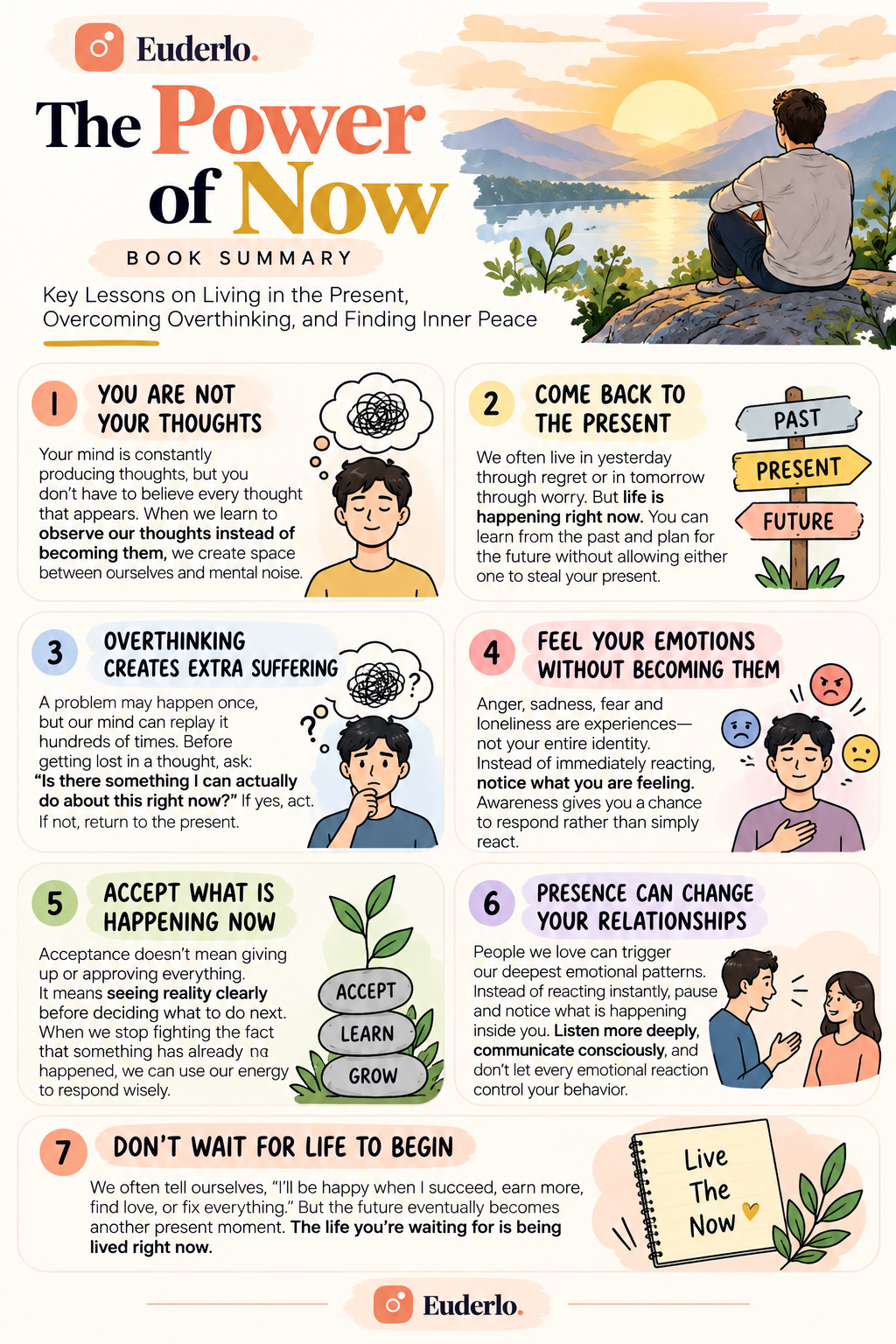
https://euderlo.com/uploads/infographics/the-power-of-now-7-key-ideas-euderlo-infographic.webp

Chapter 1: You Are Not Your Mind

The first major idea in The Power of Now is that you are not your thoughts. We spend most of our lives listening to the voice inside our heads so automatically that we rarely question it. You wake up and immediately start thinking about yesterday, today's responsibilities, tomorrow's problems, your relationships, money, career, success, failure, or what other people think about you. The mind keeps producing one thought after another, and because we are so used to this process, we often assume that the voice in our head is who we are. Eckhart Tolle challenges this assumption. He explains that there is a difference between thinking and being aware that you are thinking. The moment you notice your thoughts, you are already standing slightly outside them. For example, if your mind says, “I am not good enough,” you can believe that statement and allow it to control your emotions, or you can notice, “I am having the thought that I am not good enough.” That small difference can completely change your relationship with your mind. The thought is still there, but you are no longer automatically identified with it. This is particularly important if you struggle with overthinking, negative thoughts, self-doubt, anxiety about the future, or constantly replaying the past. We often try to stop overthinking by fighting with our thoughts, but Tolle suggests a different approach: become aware of the thinking itself. You don't have to fight every thought or force your mind to become completely silent. Instead, you can observe what is happening inside you. When you become the observer, the thought begins to lose some of its power. This is one of the central lessons of The Power of Now: you are the awareness behind your thoughts, not simply the thoughts themselves.

Chapter 2: Consciousness — The Way Out of Pain

Tolle then takes this idea deeper by explaining how identification with the mind can create psychological suffering. Life will naturally bring difficult experiences. We will experience rejection, heartbreak, disappointment, failure, loss, uncertainty, financial pressure, relationship problems and unexpected changes. We cannot completely remove pain from human life. However, our minds often take an existing painful situation and continue recreating it through thought. Something may happen for ten minutes, but we can replay it for ten days. Someone may say something hurtful, but our mind keeps repeating the conversation and imagining what we should have said. A relationship may end, but we may spend months creating stories about why it happened, whether the person will return, what we did wrong, or what our future will look like without them. The original event has ended, but mentally we continue experiencing it. This is where awareness becomes important. Instead of immediately becoming lost in emotional reactions, we can notice what is happening inside us. We can feel an emotion without allowing the emotion to become our entire identity. If anger appears, we can notice anger. If sadness appears, we can notice sadness. If fear appears, we can notice fear. This doesn't mean pretending that everything is fine or ignoring genuine problems. It means learning to separate the experience from the story we continuously build around it. When we become more conscious of our emotional patterns, we may begin to understand why certain situations trigger such strong reactions. This can be especially useful for anyone trying to understand emotional pain, emotional attachment, relationship suffering, negative thinking and how to find inner peace. The goal is not to become emotionless. The goal is to become conscious enough that emotions don't automatically control every decision we make. Tolle's teachings explore consciousness, Presence, and the relationship between awareness and the thinking mind.

Chapter 3: Moving Deeply Into the Now

The central idea of the entire book is contained in its title: the power of now comes from learning to actually experience the present moment. It sounds simple because we are technically always in the present, but psychologically we are often somewhere else. Your body may be sitting in your room while your mind is living in a conversation that happened yesterday. You may be eating dinner while thinking about tomorrow's meeting. You may be talking to someone you love while checking your phone and thinking about something completely different. Tolle asks us to recognize this constant movement of attention and return to the experience happening right now. This doesn't mean that we should stop planning for the future or learning from the past. Planning is useful, and memory is useful. The problem begins when the past and future take over our entire psychological life. The present moment is the only moment we can actually experience directly. We can remember yesterday, and we can imagine tomorrow, but we can only live now. This idea connects strongly with mindfulness and present-moment awareness. You can practice it in extremely ordinary situations. When you drink tea, actually notice the taste and warmth. When you walk, notice your feet touching the ground. When someone speaks to you, listen instead of preparing your next response. When you watch the sunset, actually look at it instead of immediately thinking about taking a photograph. These small moments may seem insignificant, but they teach us something important: life is not only the major achievements we are waiting for. Life is also everything happening between those achievements. If you are interested in practical personal growth, you can also read Euderlo's guide to becoming the best version of yourself, which explores self-improvement from a more practical perspective.

Chapter 4: The Mind's Escape From the Present

One of the reasons living in the present is difficult is that the mind often uses the past and future as places to escape. Sometimes the present moment feels uncomfortable, so we mentally leave it. If you don't like your current job, you may constantly imagine the career you want someday. If you are dealing with heartbreak, you may spend hours replaying the relationship. If you are uncertain about your future, your mind may continuously create imaginary scenarios about what could go wrong. Thinking about the future is not automatically bad, and thinking about the past is not automatically bad. The important question is whether thinking is helping you take useful action or simply keeping you trapped in mental repetition. If you have a problem that can be solved, use your mind to solve it. If you need to prepare for tomorrow, prepare. But once you have done what you can do, constantly worrying may not provide any additional solution. We can learn to ask ourselves, “Is there something I can actually do about this right now?” If the answer is yes, take the necessary action. If the answer is no, return your attention to the present. This is one of the most practical lessons for anyone searching for how to stop overthinking, how to stop worrying about the future, how to live in the present moment, and how to control negative thoughts. You don't need to eliminate every concern from your mind. You need to learn when thought is useful and when it has become repetitive mental noise. If you want to turn the ideas from the book into daily mindfulness and present-moment practices, Practicing the Power of Now provides exercises and techniques based on the original teachings.

Chapter 5: The State of Presence

As we become more aware of our thoughts, we can begin experiencing what Tolle calls presence. Presence means giving your attention to the moment instead of allowing your mind to constantly pull you somewhere else. Imagine having a conversation without thinking about your phone, your next task or what you want to say. Imagine walking without mentally replaying yesterday. Imagine sitting quietly without immediately reaching for entertainment. These experiences may seem ordinary, but they can feel surprisingly different when you are fully present. We live in a world where distraction is everywhere. We can constantly consume information, scroll through social media, watch videos, answer messages and compare our lives with millions of other people. Our attention is continuously being pulled outward. Tolle's message is essentially an invitation to take some of that attention back. You don't need to escape the world to become peaceful; you need to become more conscious of how you experience the world. Presence doesn't mean that problems disappear. You can still have bills, responsibilities, difficult conversations and goals. The difference is that you are not adding unnecessary mental suffering to every situation. You begin responding to life rather than constantly reacting to the stories created by your mind. This is why the book remains relevant to people interested in mindfulness, meditation, mental clarity, self-awareness, emotional balance and inner peace.

Chapter 6: The Inner Body

Tolle also suggests using awareness of the physical body as a doorway into the present moment. This is practical because your body is always here. Your mind can travel backward into memories or forward into imagined possibilities, but physical sensations are happening now. You can close your eyes and notice your hands. Feel your fingers without moving them. Notice your feet. Feel your breathing. Notice the sensations in your chest, stomach and shoulders. You don't need to analyze anything. You simply observe. This can become a useful grounding practice when you feel overwhelmed by thoughts. Instead of allowing your mind to create another ten imaginary situations, you return attention to something real and immediate. Your body can become an anchor to the present moment. This doesn't mean ignoring your thoughts. It means remembering that your existence is larger than your mental activity. We often spend so much time living inside our heads that we forget we are physical beings experiencing the world through our senses. Bringing awareness into the body can therefore become a simple way to practice presence throughout the day.

Chapter 7: Portals Into the Unmanifested

At this point, The Power of Now moves into more spiritual territory. Tolle explores consciousness, being and what he describes as a deeper dimension of existence beyond the thinking mind. You don't necessarily have to interpret every spiritual idea in exactly the same way to understand the practical message underneath it. Much of what he is exploring concerns our attachment to identity. We often define ourselves through our jobs, relationships, possessions, achievements, appearance, social status and personal history. We say, “This is who I am,” based on what we have accumulated or experienced. But all of these things can change. You can lose a job. A relationship can end. Your financial situation can change. Your appearance changes with age. Your opinions evolve. If your entire sense of identity depends on these external circumstances, your inner stability will constantly be vulnerable. Tolle encourages us to discover a deeper sense of being that isn't completely dependent on external achievements. You are more than your job title, your salary, your relationship status, your mistakes or your successes. This idea can be especially meaningful when we approach self-improvement carefully. Growth doesn't have to mean constantly convincing ourselves that we are inadequate and need to become someone else. We can work toward a better life while also learning to accept our present existence.

Chapter 8: Enlightened Relationships

Relationships become one of the strongest places where our unconscious patterns appear. You may feel peaceful when you are alone, but then someone you love says something that triggers you and suddenly your emotional state changes. Why does this happen? Because relationships can activate expectations, attachment, fear, insecurity and the desire to be validated. We may unconsciously expect another person to make us happy, remove our loneliness or behave exactly as we want. But no person can permanently fulfil all of those expectations. People change, circumstances change and relationships change. Tolle encourages us to bring awareness into these situations. When someone upsets you, instead of immediately reacting, you can pause and notice what is happening inside you. Maybe you feel anger. Maybe you feel rejected. Maybe you feel afraid of losing the person. Maybe an old insecurity has been activated. Awareness doesn't mean accepting disrespect or staying in an unhealthy relationship. You can still establish boundaries, communicate honestly and leave situations that are harmful. The difference is that you become more conscious of your own reactions instead of allowing every emotional trigger to control your behavior. This is particularly useful when thinking about healthy relationships, emotional attachment, relationship anxiety, heartbreak, communication and self-awareness in love.

Chapter 9: Beyond Happiness and Unhappiness

We naturally want happiness, but Tolle challenges the idea that a meaningful life means feeling happy all the time. Life contains both pleasant and unpleasant experiences. We will experience success and failure, love and loss, excitement and boredom, certainty and uncertainty. If our entire sense of wellbeing depends on circumstances always going our way, we will constantly be vulnerable to disappointment. The deeper goal is not to become someone who never feels sadness or fear. The goal is to develop enough awareness that difficult emotions don't completely define us. You can be sad without deciding that your entire life is meaningless. You can experience failure without deciding that you are a failure. You can feel afraid without assuming that everything you fear will actually happen. This distinction is extremely important for emotional resilience. We often add another layer of suffering to difficult experiences by judging ourselves for having them. We think, “I shouldn't feel this way,” and then we suffer because we are suffering. Presence allows us to acknowledge the emotion first. We can then decide what action is appropriate. This doesn't magically remove pain, but it can prevent the mind from endlessly multiplying it.

Chapter 10: The Meaning of Surrender

One of Tolle's final major ideas is surrender. At first, surrender may sound like weakness or giving up, but that is not the point. Surrender means accepting the reality of the present moment instead of continuously fighting against the fact that it has already happened. Imagine that it is raining when you planned to go outside. You can spend the next hour thinking, “This shouldn't be happening,” but your resistance doesn't stop the rain. You can instead acknowledge the reality and decide what to do: take an umbrella, change your plan or wait. The same principle can apply to difficult experiences. Acceptance doesn't mean approval. It doesn't mean that you stop improving your circumstances. It means you stop wasting unnecessary energy arguing mentally with reality. Once you acknowledge what is happening, you can respond more clearly. Acceptance and action can exist together. We can say, “This is my current situation,” and then ask, “What can I do from here?” That question is often much more useful than repeatedly asking why reality isn't different. Learning to live in the present moment means redirecting your attention away from constant regret about the past and worry about the future.

Final Takeaway

The deepest lesson of The Power of Now is surprisingly simple: we spend so much of our lives preparing to live that we sometimes forget to actually live. We tell ourselves that we will finally relax after we earn more money, become successful, find the right relationship, solve our problems or reach some future version of ourselves. But there is always another goal waiting. Another responsibility appears. Another problem needs attention. Another future arrives and immediately becomes the present. If we keep postponing our ability to experience life until everything becomes perfect, we may spend years waiting for a moment that never arrives. Tolle isn't saying that goals don't matter. They do. We should build careers, improve our health, develop meaningful relationships, create businesses, learn new skills and work toward our dreams. But we should not sacrifice the entire present while trying to build a better future. You can plan for tomorrow while being present today. You can learn from yesterday without living inside it. You can improve yourself without constantly telling yourself that who you are right now isn't enough. That is what makes The Power of Now different from a typical productivity or self-help book. It asks us to look underneath achievement and ask whether we are actually present for the life we are building. If you are interested in this broader idea of intentional living, you can also explore Euderlo's 7 Habits of Highly Effective People summary, which explores principles, priorities, relationships and purposeful action. And if you want to explore more books that can help you learn, grow and build a better life, you can continue with Euderlo's book summaries and 7-Minute Book Summaries. Ultimately, The Power of Now asks us to notice something we often overlook: the life you keep waiting for is already happening. The conversation you are having, the person sitting beside you, the work in front of you, the breath you are taking and the ordinary moment you are experiencing are not interruptions before your real life begins. They are your life. We don't need to stop thinking completely. We don't need to escape our responsibilities. We simply need to become more aware of when our minds have taken us somewhere else and gently return. Come back to now. Come back to your body. Come back to the moment. Because the present may look ordinary, but it is the only place where life can actually be experienced.

THE BIG IDEAS

Top Ideas

The ideas below capture the concepts worth remembering and carrying into everyday life.

01
KEY IDEA 1

The Present Moment Is All You Really Have

We spend so much time thinking about what happened yesterday or worrying about what might happen tomorrow that we miss the moment actually in front of us. The Power of Now teaches us to bring our attention back to the present. You can learn from your past and plan for your future, but you don't have to live inside either one. When we fully experience the moment we are in, ordinary things—eating, walking, talking, working, or simply sitting quietly—can become more meaningful.

02
KEY IDEA 2

You Are Not Your Thoughts

Our minds are constantly talking, but we don't have to believe everything our minds tell us. A thought such as “I'm not good enough” is still only a thought. When you learn to observe your thoughts instead of automatically becoming them, you create space between yourself and your mental noise. That space can help you respond more calmly instead of reacting immediately. The goal isn't to stop thinking completely; it's to become aware of your thinking.

03
KEY IDEA 3

Stop Creating Extra Suffering

Pain is a natural part of life, but our minds can make that pain much bigger. We replay conversations, imagine future disasters, hold onto old memories, and repeatedly ask why something happened. We cannot always control what happens, but we can become more conscious of how we respond to it. When you notice that your mind is creating another layer of suffering, pause and return to what is actually happening right now. Sometimes the situation needs action; sometimes it simply needs acceptance.

04
KEY IDEA 4

Awareness Can Change Your Relationships

Our closest relationships often reveal the emotional patterns we don't notice when we're alone. Someone's words can trigger anger, jealousy, fear, insecurity, or attachment. Instead of immediately reacting, Tolle encourages us to become aware of what is happening inside us. When you pause before reacting, you give yourself a choice. You can still communicate honestly, set boundaries, disagree, or walk away, but you don't have to let every emotional reaction control your behavior. Greater awareness can lead to healthier and more conscious relationships.

05
KEY IDEA 5

Acceptance Doesn't Mean Giving Up

Sometimes we waste enormous amounts of energy wishing reality were different. We think, “This shouldn't have happened,” “They shouldn't have treated me this way,” or “My life should be somewhere else by now.” Acceptance means seeing the present situation clearly before deciding what to do next. It doesn't mean that you approve of everything or stop trying to improve your life. Once we accept what is happening, we can use our energy to take meaningful action instead of continuously fighting reality in our minds.

PUT IT INTO PRACTICE

Life Lessons

Simple lessons that turn the book's ideas into practical ways of thinking and acting.

LESSON 01 ✓

Your Attention Is a Form of Wealth

We often think money is our most valuable resource, but The Power of Now makes you notice another one: your attention. Wherever your attention goes, your experience of life follows. If you spend most of your day replaying old conversations, comparing yourself with others, or imagining everything that could go wrong, you're giving your life to thoughts instead of the moment. We may not be able to control everything around us, but we can become more careful about where we place our attention.

LESSON 02 ✓

Not Every Feeling Needs an Immediate Reaction

A strong emotion can make us believe that we must act immediately. We get angry and send the message. We feel rejected and withdraw. We become afraid and make a decision simply to escape the feeling. Tolle's ideas suggest another possibility: feel the emotion before you obey it. Give yourself enough space to notice what is happening inside you. Sometimes the feeling contains useful information; sometimes it is an old pattern being triggered. That pause can change the choices we make.

LESSON 03 ✓

A Better Future Cannot Be Built by Hating the Present

It's easy to believe that we'll finally be satisfied after achieving something—a better job, more money, a relationship, success, or some future version of ourselves. But if we constantly dislike where we are, we can turn self-improvement into permanent dissatisfaction. The lesson is not to stop growing. Grow without making your present life something you constantly need to escape from. We can work toward tomorrow while still being present for today.

LESSON 04 ✓

Your Mind Can Turn One Moment Into a Whole Story

Something happens, and almost immediately our mind begins explaining it. Someone doesn't reply, so we assume they are ignoring us. Someone criticizes our work, so we decide they don't respect us. A relationship ends, and we start imagining what the rest of our life will look like. The event and the story are not always the same thing. Before believing the story your mind creates, look at what actually happened. That simple habit can prevent a lot of unnecessary suffering.

LESSON 05 ✓

Peace Doesn't Require a Perfect Life

We often imagine that inner peace will arrive once our problems disappear. But life will always contain something uncertain, unfinished, or difficult. The Power of Now suggests that peace can begin in the way we relate to those circumstances rather than waiting for circumstances to become perfect. You can work on your problems without allowing them to occupy your entire inner world. There can be difficulty in your life without difficulty becoming the whole of your life.

LESSON 06 ✓

Come Back Before You Miss Your Own Life

There are moments when we are physically somewhere but mentally somewhere completely different. We eat while scrolling, talk while thinking about work, travel while worrying about tomorrow, and sit with people we love while our minds are somewhere else. Years can pass through this pattern almost unnoticed. The lesson is simple but powerful: come back to the moment you are actually living. Look around. Listen properly. Feel what you're doing. The ordinary moments we overlook are not waiting rooms for life—they are life itself.

IS THIS BOOK FOR YOU?

Who Should Read This Book?

People Who Overthink Everything

If you spend hours replaying conversations, imagining worst-case scenarios, worrying about the future, or questioning decisions you already made, this book can help you look at your relationship with your thoughts differently. It encourages you to notice overthinking instead of automatically getting carried away by it.

People Going Through Emotional Pain

If you're dealing with heartbreak, disappointment, loneliness, attachment, or a difficult phase of life, the book offers ideas about observing emotions without allowing them to completely take over your sense of self. It can help you understand why the mind sometimes keeps reopening wounds that have already happened.

People Who Feel Mentally Exhausted

If your mind rarely becomes quiet and you constantly jump from one thought to another, The Power of Now may give you a different way to approach mental noise. Its focus on present-moment awareness can encourage you to slow down and pay attention to what is actually happening.

People Interested in Mindfulness and Spiritual Growth

If you're curious about mindfulness, consciousness, meditation, inner peace, self-awareness, or spiritual awakening, this book explores these subjects through Eckhart Tolle's perspective.

People Who Are Constantly Waiting for “Someday”

If you keep telling yourself that you'll enjoy life after becoming successful, finding the right person, making more money, or solving all your problems, this book asks you to reconsider that mindset. Your future matters, but so does the life you're living while trying to reach it.

Anyone Who Wants to Understand Their Own Mind Better

You don't need to be spiritual or interested in meditation to take something from the book. If you've ever wondered why you overthink, why certain emotions control you, or why it's difficult to stay present, the ideas can give you another perspective to explore.

TURN READING INTO ACTION

Practical Challenges

7 -DAY CHALLENGE

7-Day Challenge

7-Day The Power of Now Challenge
Day 1 — Notice Your Thoughts: Spend 10 minutes observing your thoughts without trying to change them. Simply notice what your mind keeps returning to.
Day 2 — Come Back to Now: Whenever you catch yourself worrying about the future or replaying the past, pause and bring your attention back to what you are doing.
Day 3 — Practice Mindful Breathing: Spend 10 minutes focusing only on your natural breathing. When your mind wanders, gently return to your breath.
Day 4 — Feel Your Body: Sit quietly and notice the sensations in your hands, feet, chest, shoulders, and face without judging them.
Day 5 — Stop One Overthinking Loop: When you notice repetitive thinking, ask yourself, “Is there something I can actually do about this right now?”
Day 6 — Be Fully Present With Someone: Have one conversation without checking your phone or mentally preparing your next response. Simply listen.
Day 7 — Experience One Ordinary Moment: Choose something simple—tea, a walk, a meal, or watching the sky—and experience it without distraction.
21 -DAY CHALLENGE

21-Day Challenge

21-Day The Power of Now Challenge
Week 1 — Become Aware
Spend 10 minutes observing your thoughts.
Notice how often your mind returns to the past.
Notice how often you worry about the future.
Practice five minutes of mindful breathing.
Become aware of your body several times during the day.
Eat one meal without your phone.
Write down the three thoughts that distracted you most during the week.
Week 2 — Practice Presence
Give your complete attention to one task at a time.
Take a 15-minute walk without using your phone.
Listen carefully during every important conversation.
When anger appears, pause before responding.
When sadness appears, observe it instead of immediately escaping it.
Spend 20 minutes without social media, videos, or unnecessary digital stimulation.
Sit quietly for 15 minutes and simply notice your surroundings.
Week 3 — Live the Idea
Catch yourself whenever you say, “I'll be happy when…”
Separate an actual problem from the story your mind is creating around it.
Practice accepting one thing you cannot currently change.
Notice one emotional reaction before acting on it.
Spend an hour doing something without multitasking.
Before sleeping, reflect on how much of your day you actually experienced consciously.
Write one sentence answering: “What would change if I became more present in my everyday life?”
90 -DAY CHALLENGE

90-Day Challenge

90-Day The Power of Now Challenge
Days 1–30 — Awareness
Practice 10 minutes of present-moment awareness every day.
Observe your thoughts without immediately believing them.
Notice your most common overthinking patterns.
Practice mindful breathing daily.
Spend a few minutes feeling your body each day.
Reduce unnecessary phone checking.
Eat at least one meal mindfully.
Take regular walks without digital distractions.
Notice when you mentally escape into the past.
Notice when you mentally escape into the future.
Pause before reacting emotionally.
Listen more carefully when people speak.
Spend quiet time without entertainment.
Notice your emotional triggers.
Write down recurring negative thoughts.
Ask whether each worry requires action.
Practice returning your attention to the present.
Notice moments when you compare yourself with others.
Observe your desire for external validation.
Spend time appreciating something ordinary.
Practice being completely present during one daily activity.
Notice how your body reacts to stress.
Take three conscious breaths whenever you feel overwhelmed.
Stop replaying one unnecessary past conversation.
Spend 20 minutes without your phone.
Observe your thoughts before sleeping.
Practice accepting something you cannot control.
Notice when your mind creates unnecessary stories.
Review the changes you have noticed.
Write down your biggest lesson from the first month.
Days 31–60 — Deeper Presence
Increase your daily awareness practice to 15 minutes.
Practice mindful walking.
Practice mindful eating.
Give someone your complete attention.
Spend an evening without unnecessary scrolling.
Observe anger without immediately expressing it.
Observe fear without immediately running from it.
Notice attachment in your relationships.
Practice responding instead of reacting.
Spend time in silence.
Notice when you are trying to control something you cannot control.
Separate facts from assumptions.
Notice when your identity depends on achievement.
Spend time doing nothing without reaching for your phone.
Practice gratitude for something happening now, not only something you hope to have later.
Take a slow walk and notice your surroundings.
Observe your thoughts during stressful situations.
Practice accepting an uncomfortable moment.
Have a conversation without interrupting.
Notice how quickly your attention moves away from the present.
Bring your attention back without judging yourself.
Spend one hour doing only one activity.
Notice what triggers unnecessary worry.
Practice letting one small frustration pass without reacting.
Sit quietly and observe your breathing.
Reflect on how your relationships change when you are more present.
Notice whether you are living according to future expectations.
Practice being fully present during work.
Review your emotional patterns.
Write down how your relationship with your thoughts has changed.
Days 61–90 — Make Presence a Way of Living
Begin each morning without immediately checking your phone.
Spend the first few minutes noticing your surroundings.
Set an intention to remain present during the day.
Practice conscious breathing whenever you transition between tasks.
Listen completely during conversations.
Practice mindful eating every day.
Take regular phone-free walks.
Notice thoughts without automatically following them.
Pause before important reactions.
Practice acceptance when plans change.
Notice whether you are mentally living in the past or future.
Return to the present whenever you catch yourself drifting.
Spend 30 minutes in quiet awareness.
Observe your emotional reactions without judging yourself.
Practice being present during difficult conversations.
Stop using constant entertainment to escape uncomfortable feelings.
Notice when you seek validation from others.
Spend an hour without unnecessary digital stimulation.
Practice enjoying an ordinary moment without photographing or sharing it.
Notice how much of your day is spent thinking versus actually experiencing.
Practice surrendering one situation you cannot control.
Focus completely on the task in front of you.
Observe your mind during moments of uncertainty.
Practice staying present when you feel uncomfortable.
Notice the difference between a real problem and mental worry.
Spend meaningful, distraction-free time with someone you care about.
Reflect on how your relationship with yourself has changed.
Write down five moments when being present helped you.
Create three personal rules for staying present in everyday life.
Final Day — Ask yourself: “Am I simply waiting for a better life, or am I actually experiencing the life I am living right now?”
COMMON QUESTIONS

Frequently Asked Questions

1. What is The Power of Now about?
The Power of Now by Eckhart Tolle is about living in the present moment, understanding your mind, overcoming overthinking, and developing greater awareness. The book explores why we become trapped in thoughts about the past and future and encourages us to experience the “Now” more consciously. Tolle connects present-moment awareness with inner peace, emotional clarity, and a deeper understanding of ourselves.
2. What is the main message of The Power of Now?
The central message is that the present moment is where life actually happens. We can learn from the past and prepare for the future, but we experience neither directly—we experience this moment. The book encourages you to notice when your mind becomes trapped in regret, worry, comparison, or repetitive thinking and gently bring your attention back to what is happening now.
3. How can The Power of Now help with overthinking?
The book approaches how to stop overthinking by encouraging you to observe your thoughts instead of automatically believing or following them. When we notice that the mind is creating another worry, memory, or imagined scenario, we can step back and become aware of the thinking process itself. This doesn't mean you should never think about problems; rather, you learn to distinguish useful thinking from repetitive mental noise.
4. What does Eckhart Tolle mean by living in the present moment?
Living in the present means giving more of your attention to what is actually happening right now rather than constantly being psychologically absorbed in yesterday or tomorrow. You can still make plans, work toward goals, and learn from your experiences. The difference is that you don't allow past regrets or future worries to completely take you away from the life you are experiencing today. Tolle's official teachings describe present-moment awareness as central to his approach.
5. How do you practice The Power of Now in everyday life?
You don't necessarily need a complicated meditation routine. You can begin by paying attention to ordinary experiences. When you eat, notice the food. When you walk, notice your body and surroundings. When someone speaks, actually listen. When you notice yourself overthinking, pause and observe the thought. Tolle's Practicing the Power of Now was specifically developed to make the ideas more practical through exercises and practices.
6. Is The Power of Now about mindfulness?
Yes, many of its ideas overlap strongly with mindfulness and present-moment awareness. The book encourages you to become conscious of your thoughts, emotions, body, and immediate surroundings rather than living automatically. Tolle's official materials also describe practices involving breathing, sense perception, and inner-body awareness as ways of returning attention to the present.
7. What does The Power of Now say about the ego?
Tolle presents the ego as a mind-created sense of identity that can become attached to possessions, achievements, opinions, roles, memories, and other forms of identification. When we become completely identified with these things, changes in our circumstances can strongly affect our sense of self. The book encourages greater awareness of this identification and points toward a deeper sense of being beyond the constant activity of the thinking mind.
8. Can The Power of Now help you find inner peace?
The book is centered heavily on inner peace, presence, awareness, and freedom from compulsive identification with thought. It doesn't suggest that your external life will suddenly become problem-free. Instead, it explores how changing your relationship with thoughts and difficult emotions may create more space and awareness even when circumstances are challenging. The official description specifically connects the book with finding inner peace, greater joy, and more harmonious relationships.
9. Who should read The Power of Now?
This book may appeal particularly to readers interested in self-improvement, mindfulness, spirituality, meditation, personal growth, emotional awareness, overthinking, consciousness, and inner peace. It can also be interesting if you feel mentally exhausted from constantly thinking about the past or worrying about the future. Tolle's own companion book notes that Practicing the Power of Now can also serve as an introduction for readers who found the original book overwhelming.
10. What is the biggest lesson from The Power of Now?
Perhaps the simplest lesson is this: don't become so busy thinking about your life that you forget to experience it. We can spend years waiting for the next achievement, relationship, amount of money, career opportunity, or future version of ourselves. But when tomorrow arrives, it becomes another “now.” The book invites you to keep growing and planning while also learning to appreciate the moment you are actually living. As Tolle's official site puts it, present-moment awareness is a foundation of his teaching.
Explore This Book
Self-Improvement #The Power of Now #Eckhart Tolle #Eckhart Tolle Books #Book Summary #The Power of Now Summary #The Power of Now Book Summary #Chapter by Chapter Summary #Living in the Present Moment #Present Moment Awareness #Mindfulness #Inner Peace #Self-Awareness #Personal Growth #Personal Development #Spiritual Growth #Consciousness #Spiritual Awakening #Overthinking #How to Stop Overthinking #Negative Thoughts #Emotional Healing #Emotional Awareness #Ego #Letting Go #Acceptance #Surrender #Meditation #Mindful Living #Mental Clarity #Finding Inner Peace #Happiness #Self-Improvement #Life Lessons #Spirituality #Mindfulness Practice #How to Live in the Present #How to Find Inner Peace #Books on Mindfulness #Best Self-Help Books