These actions may not feel life-changing habits when you do them once. But repeat them for months and they can influence your health, mindset, relationships, finances, productivity, and confidence. Your life is largely shaped by what you repeatedly do, not by what you occasionally intend to do.
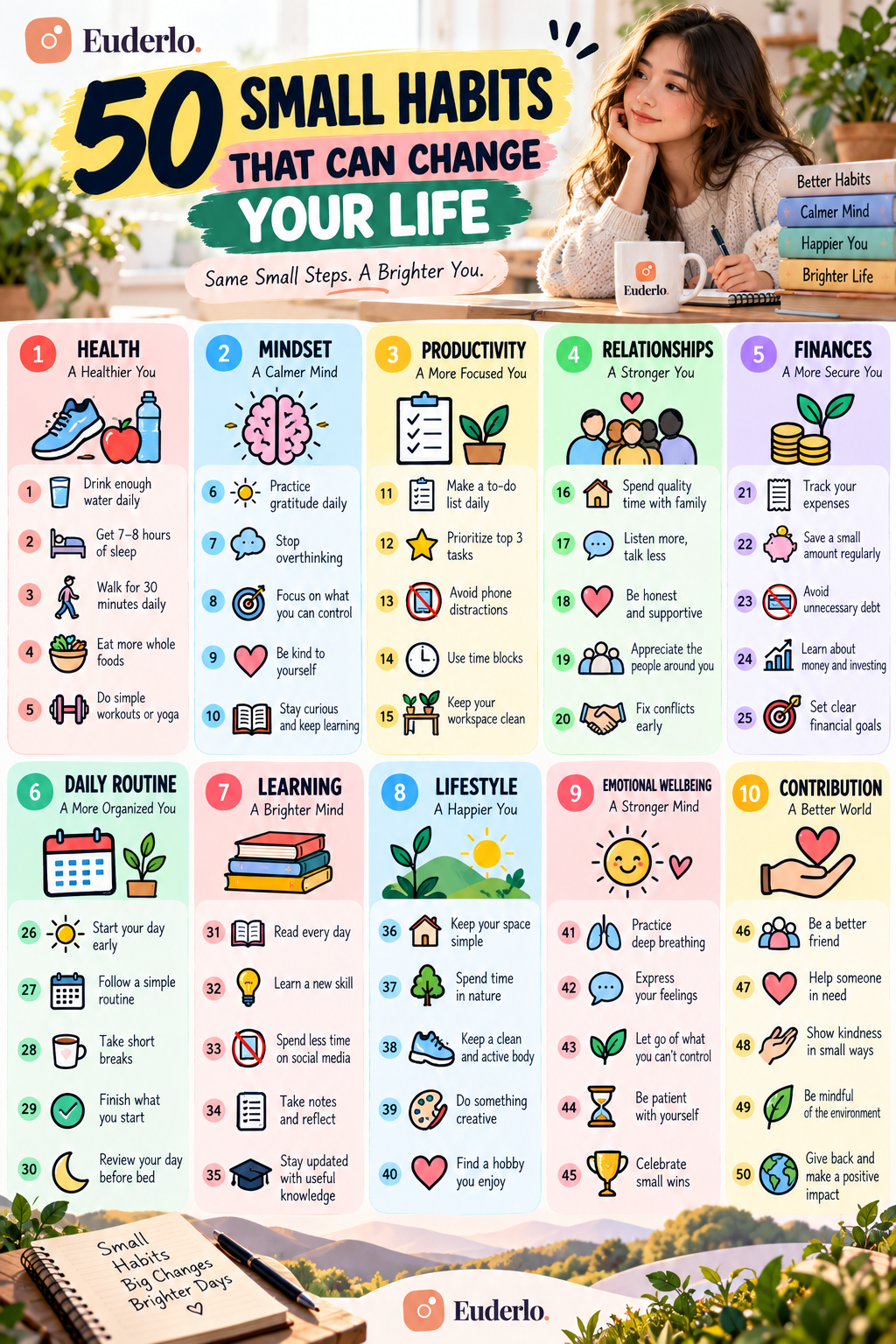
In this guide, you'll discover 50 small habits that can change your life and learn how to make them realistic, sustainable, and easier to maintain. You don't need to start with all 50. Start with one.
On this page
Jump directly to the part you want to read.
There is a version of you that you probably imagine from time to time. Maybe that person wakes up without immediately reaching for the phone, takes care of their body, manages money responsibly, reads regularly, finishes important work, maintains meaningful relationships, sleeps peacefully, and generally feels more in control of life. When we think about becoming that person, we often imagine that something dramatic has to happen first. We think we need a completely new routine, a new job, a new city, more money, more motivation, or a perfect 5 AM morning routine. But the truth is usually much quieter. A better life is often built through small habits repeated long enough to become part of who we are.
Think about the things that shape your life today. Your health is influenced by what you repeatedly eat, how often you move, and how you sleep. Your finances are influenced by what you repeatedly spend, save, and learn. Your career is influenced by what you repeatedly practice. Your relationships are influenced by how often you communicate, listen, show appreciation, and make time for people. Even your confidence can be influenced by the promises you repeatedly keep to yourself. This is why small daily habits deserve more attention than dramatic life transformations.
One walk will not transform your health. One book will not make you knowledgeable. One saved ₹100 will not make you financially secure. One productive morning will not change your career. One conversation will not repair every relationship. But repeat those behaviours for months and years, and you are no longer looking at isolated actions. You are looking at a lifestyle.
Research on habit formation supports this idea while also warning us against simplistic claims such as "every habit takes exactly 21 days." Habits can take different amounts of time to become automatic depending on the behaviour, person, environment, and consistency. The useful lesson is not to obsess over a number. It is to repeat a behaviour in a consistent context until it becomes easier and more natural. Habit formation research — Lally et al.
That is the philosophy behind this list of 50 small habits that can change your life. You do not need to adopt all 50. Please don't. Choose the ones that solve problems you actually have. Start small enough that you can continue even when motivation disappears. Your goal is not to become perfect. Your goal is to make your ordinary days a little better.
1. Wake Up at a Consistent Time
You don't need to wake up at 5 AM because someone on social media told you successful people do it. Your body does not care about an internet productivity trend. What matters is developing a sleep-wake schedule that works with your responsibilities and allows you to get enough sleep. A consistent morning routine can make the beginning of your day more predictable and reduce the number of decisions you have to make immediately after waking. If you currently wake up at completely different times every day, start by choosing a realistic window and gradually make it more consistent.
2. Stop Checking Your Phone Immediately
For many of us, the first thing we see in the morning isn't sunlight, our family, or our own thoughts. It's a screen full of messages, notifications, headlines, reels, and other people's lives. Try giving yourself even 15–30 minutes before checking social media. You don't have to completely eliminate your phone. Just create a small space between waking up and consuming information. One of the simplest healthy morning habits is allowing your mind to wake up before the internet starts telling you what deserves your attention.
3. Drink Water After Waking
Keep a glass or bottle of water somewhere visible and make drinking water part of your morning. This isn't a magical detox trick, and you don't need to believe exaggerated health claims to benefit from a basic habit. It's simply an easy way to begin the day with hydration. The best healthy habits for everyday life are often the boring ones that make sense and are easy to repeat.
4. Make Your Bed
Making your bed won't make you rich or successful, but it can give you a tiny feeling of completion before the day properly begins. More importantly, it teaches a useful principle: finish small things instead of allowing everything to remain unfinished. You don't need to romanticise it. Pull the blanket up, arrange the pillow, and move on. Small habits for a better life don't need to be impressive to be useful.
5. Get Some Natural Morning Light
Spend a few minutes outside in the morning or expose yourself to natural daylight when practical. Morning light is connected to the body's circadian system, which helps regulate the sleep-wake cycle. You can combine this with another habit by walking outside, drinking your morning beverage near a window, or simply stepping onto a balcony. The goal isn't to create another complicated wellness ritual. It's to make natural light and movement normal parts of your morning.
6. Walk Every Day
If you asked me for one of the simplest habits for a healthier life, I would tell you to walk. You don't need an expensive gym membership or an advanced workout program to start moving more. Walk after dinner, during a lunch break, while talking on the phone, or simply around your neighborhood. The World Health Organization recommends adults accumulate 150–300 minutes of moderate-intensity aerobic physical activity per week, while also recommending muscle-strengthening activity on at least two days a week. WHO Physical Activity Guidelines. Start with what you can realistically maintain.
7. Stretch for Five Minutes
Long hours sitting at a desk can leave your body feeling stiff. A few minutes of gentle stretching can become a useful transition between periods of sitting, exercise, or sleep. You don't need a complicated flexibility program. The habit is simply to pay attention to your body instead of treating it like a machine you only remember when something hurts. Taking care of your body every day begins with noticing it.
8. Add One Nutritious Food to Your Day
Instead of beginning another extreme diet, try adding something nutritious to your normal meals. Add fruit to breakfast, vegetables to lunch, nuts as a snack, or legumes to a meal. This approach is psychologically easier because you're thinking about what you can add rather than creating a huge list of forbidden foods. Healthy eating habits don't have to mean eating perfectly. They mean gradually creating patterns that support your health.
9. Slow Down While Eating
Put your phone away for one meal and actually experience the food. Eat at a reasonable pace, notice the flavors, and pay attention to how you feel. Many of us eat while watching something, scrolling through something, working, or answering messages. One phone-free meal can become a surprisingly peaceful part of your day. You don't have to practice perfect mindfulness; simply being present is already an improvement.
10. Protect Your Sleep
Sleep is one of those things we often sacrifice first when life becomes busy, and then wonder why we're tired, irritable, distracted, or unproductive. The CDC says adults aged 18–60 generally need at least seven hours of sleep per night, although individual needs can vary. CDC — About Sleep. Build a better sleep routine by keeping a reasonably consistent bedtime, reducing unnecessary late-night stimulation, and treating sleep as part of your health rather than leftover time after everything else is finished.
11. Read Five Pages a Day
You don't need to read 50 books this year. Start with five pages. Five pages sounds almost too easy, and that's precisely why it works as a starting point. Keep a book somewhere visible and read after dinner, before bed, or during your morning tea. Some days you'll read five pages; other days you'll read fifty. The real goal is to become someone who reads regularly. If you want to build a reading habit, make reading convenient.
12. Learn Something Every Day
Spend ten minutes learning something that interests you. Read about psychology, business, technology, history, writing, finance, health, or anything else that expands your understanding of the world. Continuous learning doesn't require going back to university. Your phone, library, books, courses, podcasts, and reputable websites can all become learning tools if you use them intentionally.
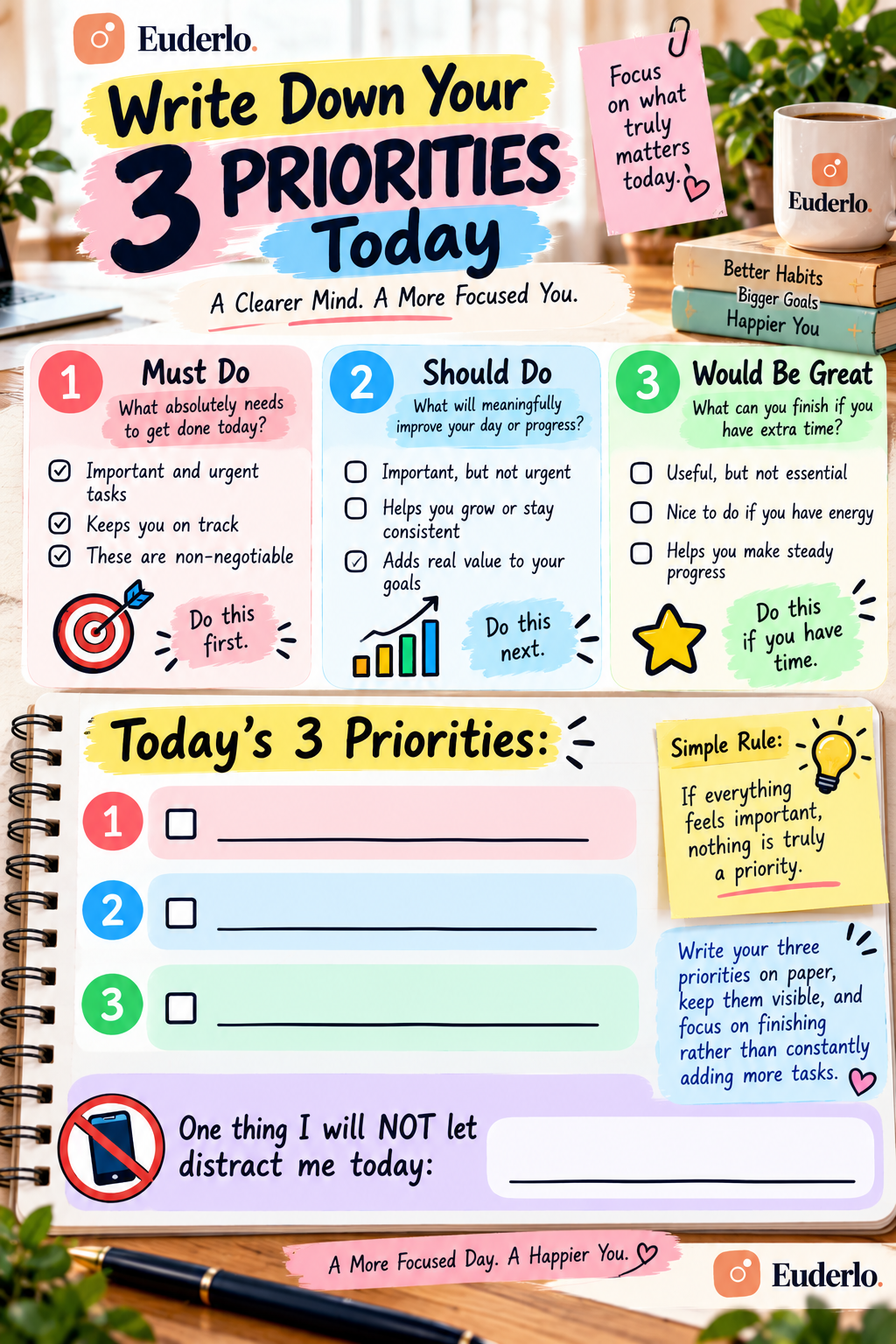
13. Write Down Your Top Three Priorities
Every morning, instead of writing a giant list of everything you could possibly do, identify three things that genuinely matter. Maybe one is work, one is health, and one is personal. A shorter daily to-do list can help you distinguish important work from noise. If you complete those three things and have more time, you can continue. But you should know what mattered before the day gets crowded.
14. Do the Hardest Important Task Earlier
There is always something we postpone because it requires effort. We answer easy messages, rearrange files, check social media, make coffee, clean something, and suddenly the day is half gone. Try doing the important task before you exhaust your attention. You don't need a perfect productive morning routine. You simply need to stop allowing low-value tasks to consume the time meant for high-value ones.
15. Use the Two-Minute Rule
When something genuinely takes around two minutes, consider doing it immediately rather than adding it to your mental list. Put the cup away. Reply to the simple message. Save the document. Throw away the receipt. The habit sounds insignificant, but small unfinished tasks accumulate into mental clutter. Not everything deserves a task-management system.
16. Put Things Back Where They Belong
Use something and put it back. It sounds almost ridiculously simple, but imagine the difference if you followed this principle consistently. Your keys have a place. Your clothes have a place. Your documents have a place. Your work tools have a place. Small organisation habits prevent small messes from becoming large ones.
17. Clean Your Workspace Before Starting
Spend two minutes clearing your immediate workspace before beginning important work. You don't need to clean the entire room. Remove the things that are unrelated to what you're about to do. A cleaner environment doesn't guarantee concentration, but reducing unnecessary distractions can make focused work easier.
18. Keep One Simple To-Do System
Your brain is excellent at thinking but terrible at remembering every obligation perfectly. Use a notebook, calendar, or task app to capture things you need to remember. Don't create a complicated productivity system with ten apps if one notebook works. The best productivity habits are the ones that survive your busiest weeks.
19. Turn Off Unnecessary Notifications
Every notification asks for a tiny piece of your attention. Most of them aren't urgent. Go through your phone and disable notifications that don't genuinely need your immediate response. Digital wellbeing doesn't require throwing your phone away. It means deciding which parts of the digital world are allowed to interrupt your real life.
20. Have One Phone-Free Meal
Choose one meal every day where the phone stays away. Talk to someone, eat slowly, or simply sit with your thoughts. At first it may feel strange because we're used to filling every quiet moment. Eventually, that silence can become something you appreciate.
21. Keep Your Phone Away From Your Bed
If your phone is beside your pillow, it's incredibly easy to turn five minutes of scrolling into an hour. Put it across the room or outside the bedroom if practical. This is an example of how to break bad habits without relying entirely on willpower. Instead of repeatedly telling yourself not to scroll, make scrolling less convenient.
22. Unfollow Accounts That Make You Feel Worse
Your digital environment influences what you repeatedly see and think about. If certain accounts consistently make you feel inadequate, angry, jealous, or distracted, you are allowed to unfollow them. You don't have to consume every opinion simply because an algorithm places it in front of you. Curate your feed like you would curate your physical environment.
23. Declutter for Ten Minutes
Don't wait until your room becomes unbearable before cleaning it. Set a ten-minute timer and choose one small area. A drawer, shelf, folder, table, or cupboard is enough. Decluttering your life becomes much easier when you stop treating it as one enormous project.
24. Save a Small Amount of Money
The first goal of saving isn't necessarily becoming wealthy. It's building the habit of keeping some of what you earn. The amount should depend on your circumstances. Even a small amount can teach you that not every rupee needs to be spent immediately. As your income and financial situation change, you can adjust the amount.
25. Look at Your Spending
You cannot improve what you never examine. Spend a few minutes checking what you spent that day or week. Don't use this exercise to shame yourself. Use it to become aware. How to improve your finances begins with knowing where your money is going.
26. Pause Before Impulse Purchases
Before buying something unnecessary, give yourself some time. For a small purchase, that might mean waiting until tomorrow. For an expensive purchase, it might mean waiting much longer and comparing alternatives. Ask yourself whether you actually want the product or simply want the temporary feeling associated with buying it.
27. Learn One Personal Finance Concept
Spend ten minutes learning about budgeting, emergency savings, insurance, investing, taxes, debt, or another relevant financial topic. Financial literacy is not about becoming an expert overnight. It is about becoming less dependent on random advice. For important financial decisions, use reliable sources and consider qualified professional advice where appropriate.
28. Call Someone You Care About
Relationships often disappear slowly rather than dramatically. We become busy, postpone calls, assume people understand, and tell ourselves we'll talk later. Don't always wait for a special occasion. Call someone you care about simply because you thought of them. Research on social relationships has found a strong association between social connection and health outcomes across a large body of evidence. Social Relationships and Mortality Risk — PLOS Medicine. A five-minute conversation isn't a substitute for every form of support, but human connection matters.
29. Say Thank You More Often
When someone helps you, tell them. When someone does something thoughtful, acknowledge it. Gratitude doesn't mean pretending everything is wonderful. It means noticing what deserves appreciation even when life is difficult. Research into gratitude interventions has found evidence of potential benefits for well-being, although results vary depending on the intervention and outcome being studied. Gratitude research — PubMed
30. Listen Without Preparing Your Response
One of the best habits for better relationships is learning to listen. When someone speaks, resist the urge to immediately prepare your reply. Ask questions. Clarify what they mean. Sometimes people don't need a solution; they need to feel heard. You don't have to agree with everything someone says to genuinely listen.
31. Apologize When You're Wrong
There is nothing powerful about refusing to admit a mistake. A sincere apology doesn't make you weak. It shows that the relationship or principle matters more than your ego. You don't need a ten-minute explanation. Sometimes "I was wrong, and I'm sorry" is enough to begin repairing something.
32. Stop Saying Yes Automatically
Before accepting every request, ask whether you genuinely have the time, energy, and desire to do it. Saying yes to everything can eventually mean saying no to your own priorities. Setting healthy boundaries isn't about becoming selfish. It is about understanding that your time and attention are limited.
33. Spend Five Minutes Alone
You don't have to meditate for an hour. Sit quietly for five minutes. Walk without headphones. Drink your tea without a screen. Let your mind wander. We spend so much time consuming information that we sometimes forget what our own thoughts sound like.
34. Write One Page
Journaling for self-improvement doesn't need to be complicated. Write what happened today, what bothered you, what you're thinking about, what you want to change, or what you're grateful for. Over time, your journal becomes a record of patterns you might otherwise miss.
35. Ask Yourself One Honest Question
At the end of the day, ask yourself: "Did the way I spent today move me closer to the life I want?" Don't use the question to attack yourself. Use it to learn. If the answer is no, tomorrow gives you another opportunity.
36. Write Down Your Worries
When something repeatedly circles through your mind, put it on paper. Then divide your worries into two categories: things you can influence and things you cannot. Work on the first category. For the second, practice accepting that uncertainty exists. Writing down worries doesn't magically remove them, but it can make vague anxiety more concrete.
37. Pause Before Reacting
When you're angry, frustrated, or hurt, create a small gap before responding. Take a breath. Walk away for a moment if necessary. Then decide what you actually want to communicate. The American Psychological Association offers practical guidance around stress management, including healthy movement, relaxation, sleep, and social support. APA — Healthy Ways to Handle Stress. The goal isn't to suppress emotions. It's to avoid allowing a temporary emotional reaction to make a permanent decision.
38. Replace "I Have To" With "I Choose To"
You don't have complete control over everything in your life, but you often have more agency than you initially feel. Instead of saying "I have to exercise," you might say "I choose to take care of my body." Instead of "I have to learn this," say "I choose to improve this skill." This small shift can remind you that some actions are connected to values you have chosen.
39. Use an If-Then Plan
Goals often fail because they remain vague. "I will exercise more" isn't a plan. "If I finish work at 6 PM, then I will walk for 20 minutes" is more specific. Research on implementation intentions has examined how these if-then plans can support goal achievement by linking a situation with a planned response. Implementation Intentions and Goal Achievement — ScienceDirect.
40. Track One Habit
Choose one habit and put a checkmark on a calendar whenever you complete it. Tracking isn't about creating guilt. It's about making invisible behavior visible. When you can see a pattern developing, you're more likely to notice what helps and what gets in the way.
41. Don't Let One Bad Day Become a Bad Week
You will miss workouts. You will eat badly sometimes. You will waste an evening scrolling. You will forget to read. You will procrastinate. That's normal. The mistake isn't missing once; the mistake is deciding that one missed day proves you cannot change. Consistency over perfection is a much healthier approach. Return to the habit as soon as you reasonably can.
42. Turn Complaints Into Questions
When you catch yourself complaining about something, ask: "Can I influence this?" If yes, identify one action. If no, ask whether continuing to spend your attention on it is helping you. This doesn't mean suppressing legitimate frustration. It means moving from endless rumination toward useful action when action is available.
43. Stop Comparing Your Life to Someone Else's
You see someone's promotion, body, relationship, business, home, holiday, or lifestyle, but you don't see their entire story. Social media makes comparison particularly easy because we're constantly shown selected moments. How to stop comparing yourself to others is partly about returning your attention to your own progress. Compare today's version of you with the person you were six months ago.
44. Celebrate Small Wins
Finished the difficult task? Recognize it. Completed your workout? Good. Saved money? Notice it. Read a book? Appreciate the progress. Celebrating doesn't mean pretending you've reached the final destination. It means giving yourself evidence that your effort is producing movement.
45. Create More Than You Consume
We spend enormous amounts of time consuming videos, posts, opinions, entertainment, and news. Try creating something too. Write a page. Build a project. Cook a meal. Take photographs. Learn an instrument. Start a small website. Teach something you know. One of the strongest habits for personal growth is moving from passive consumption toward active creation.
46. Practice Single-Tasking
Multitasking feels productive because you're doing several things, but constantly switching attention can make demanding work harder. Choose one task, remove unnecessary distractions, and work on it for 20–30 minutes. You don't need to focus for four hours. Start by protecting one short period of genuine attention.
47. Prepare Tomorrow Tonight
Before going to bed, spend five minutes preparing for tomorrow. Check your schedule, identify your priorities, put your clothes somewhere accessible, prepare something you need, or clean your workspace. Planning the next day reduces the number of decisions waiting for you in the morning.
48. Write Down Three Good Things
Before sleeping, identify three things that went well. They don't need to be extraordinary. Maybe you had a good conversation, finished your work, enjoyed dinner, took a walk, laughed with someone, or simply had ten peaceful minutes. This habit isn't about denying the difficult parts of life. It's about training yourself to notice that difficult moments are not the entirety of your experience.
49. Review Your Week
Once a week, stop and ask yourself what worked, what didn't, what drained your energy, what gave you energy, what you should stop doing, and what you want to improve next week. This weekly self-improvement routine turns your life into an ongoing learning process. You don't have to get everything right. You just need to learn from what happened.
50. Do One Thing That Makes Tomorrow Easier
This may be the simplest habit on the list. Before ending the day, ask yourself: "What can I do tonight that will make tomorrow a little easier?" Maybe you prepare breakfast, organize your desk, finish a small task, put your phone away, set out your clothes, or simply go to sleep on time. A better tomorrow often begins with a small decision tonight.
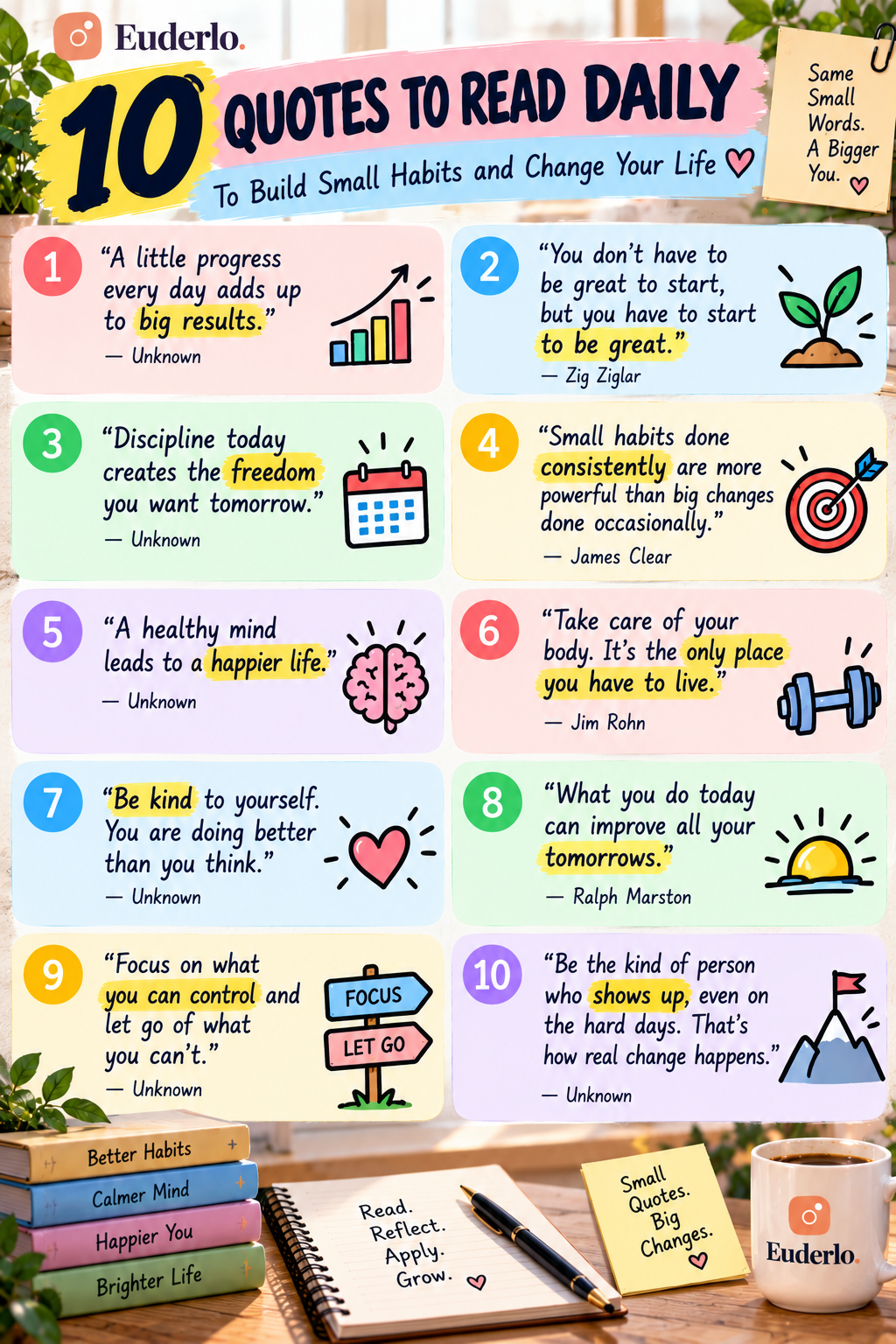
Read these quotes daily to change your life completely.
Don't Try to Start All 50 Habits
Here's something important: don't finish this article and decide that tomorrow you are going to adopt all 50 habits.
That is exactly how many self-improvement attempts fail.
You become excited, create an enormous routine, follow it for three days, miss something on the fourth day, feel guilty, and eventually abandon everything. Instead, choose three small habits that can improve your life.
If your biggest problem is health, start with walking, sleep, and better food choices. If you're distracted, start with turning off notifications, putting your phone away, and creating focused work periods. If you're struggling financially, begin by tracking spending, saving something realistic, and learning about personal finance. If you're lonely, make the phone call you've been postponing. If your mind feels chaotic, start writing things down.
Your habits should solve your problems.
That is more important than copying someone else's routine.
How to Build Habits That Actually Stick
The biggest mistake people make with how to build better habits is making the starting point too difficult. They decide to exercise for an hour every day when they haven't exercised in months. They decide to read 50 pages when they haven't opened a book in weeks. They decide to meditate for 30 minutes when they can't sit still for three.
Start embarrassingly small.
Read one page.
Walk for ten minutes.
Save ₹50.
Write three sentences.
Clean one drawer.
Do five push-ups if appropriate for you.
The purpose of making a habit small isn't to stay small forever. It is to make starting easy enough that you can build consistency.
Environment matters too. If you want to read, leave the book somewhere visible. If you want to walk, keep your shoes ready. If you want to spend less online, remove shopping apps. If you want to sleep earlier, move your phone away from the bed.
James Clear's Atomic Habits popularized a useful framework around making desirable behaviors obvious, attractive, easy, and satisfying. The larger lesson is simple: don't depend entirely on motivation when you can design your environment to support your behavior. Atomic Habits — James Clear
Why Small Changes Are Better Than Dramatic Resolutions
We love dramatic transformations because they make good stories. Someone wakes up one morning and completely changes their life. They become disciplined, lose weight, become successful, save money, read books, and suddenly everything is perfect.
Real life is rarely that clean.
You might improve your sleep and then have a stressful week. You might start exercising and then get busy. You might save money and then face an unexpected expense. You might become more productive and then have a difficult month at work.
This doesn't mean the habits failed.
It means you're human.
A sustainable self-improvement journey has room for disruption. You don't need to perform perfectly to benefit from a good behavior. The goal is to create patterns that you can return to.
The 30-Day Small Habits Reset
If you want to turn this article into action, make the next 30 days simple. During the first week, focus on your foundation: choose a consistent wake-up and bedtime, drink water, walk regularly, and reduce unnecessary phone use. During the second week, add reading, daily priorities, and one focused work period. During the third week, focus on money and relationships by tracking spending, saving something realistic, and contacting someone you care about. During the fourth week, introduce reflection through journaling, weekly review, gratitude, and preparation for the next day.
At the end of 30 days, don't ask whether you became a completely different person. Ask which behaviors became easier, which ones genuinely improved your day, and which ones you want to continue.
That is a much more useful definition of progress.
Small Habits for a Better Morning
Your morning doesn't need to look like a motivational video. A realistic morning routine for a better day could simply involve waking at a consistent time, drinking water, getting natural light, avoiding immediate social media, moving your body for a few minutes, identifying your top priorities, and beginning one meaningful task.
That's enough.
You don't need twelve supplements, a cold shower, two hours of meditation, and a perfectly organized journal to have a good morning.
Build a morning that fits your actual life.
Small Habits for a Better Night
The same principle applies to your evening. A simple night routine for better sleep might involve reducing unnecessary screen use, checking tomorrow's schedule, preparing what you need, writing down a few thoughts, and going to bed at a consistent time.
Your evening is not simply the end of today.
It is preparation for tomorrow.
What These 50 Habits Have in Common
Look closely at the entire list and you'll notice something interesting. These habits are not really about productivity.
They're about reducing friction in life.
Walking takes care of your body.
Reading develops your mind.
Saving protects your future.
Calling someone strengthens connection.
Cleaning reduces environmental friction.
Planning reduces decision fatigue.
Sleeping supports recovery.
Journaling creates reflection.
Turning off notifications protects attention.
Preparing tomorrow reduces morning chaos.
None of these actions is extraordinary.
And that is exactly the point.
We sometimes search for life-changing habits because we expect life-changing results to come from life-changing actions. But many of the most valuable things in life are ordinary actions performed consistently.
The Person You Become Through Your Habits
There is another side to habit-building that is easy to overlook.
Your habits don't only change what you do.
They gradually influence how you see yourself.
When you repeatedly read, you begin to see yourself as someone who learns.
When you exercise consistently, you begin to see yourself as someone who takes care of their body.
When you save money, you begin to see yourself as someone who thinks about the future.
When you keep promises to yourself, your confidence can grow because you have evidence that you can trust your own intentions.
This doesn't mean a habit magically changes your identity. Your identity is far more complicated than that. But repeated behavior can provide evidence about the kind of person you are becoming.
That's why the better question isn't always, "What will this habit give me?"
Sometimes ask:
"Who am I becoming by repeatedly doing this?"
What If You Keep Failing?
You will.
Everyone does.
You will have days when you don't exercise. You will waste time. You'll eat something you didn't plan to eat. You'll overspend. You'll stay up too late. You'll procrastinate. You'll lose motivation.
Don't turn a mistake into an identity.
Missing one workout doesn't mean you're lazy.
Having an unproductive day doesn't mean you're incapable.
Spending more than planned doesn't mean you'll always be financially irresponsible.
The useful response is simple: notice what happened, understand why, adjust the environment if necessary, and return to the behavior.
Never confuse a bad day with a bad life.
10 Habits to Start Today
If the list of 50 feels overwhelming, forget most of it for now. Start with ten simple behaviors: drink water after waking, walk for 20 minutes, read five pages, write your top three priorities, turn off unnecessary notifications, track your spending, save a small amount, call someone you care about, spend five minutes writing or reflecting, and prepare tomorrow before you sleep.
Even these don't need to happen perfectly.
Choose three.
Do them consistently.
Then build from there.
The Real Secret Behind a Better Life
We often want the result without the process.
We want the body without the workouts.
The financial security without the budgeting.
The knowledge without the reading.
The confidence without doing uncomfortable things.
The peaceful mind without learning how to manage attention.
The strong relationships without giving people our time.
But life doesn't work that way.
You become what you repeatedly practice.
That doesn't mean everything in life is within your control. It isn't. People have different circumstances, opportunities, responsibilities, resources, health situations, and challenges. Personal development should never become an excuse to blame people for circumstances they cannot control.
But within the areas you can influence, your choices matter.
You can decide what deserves your attention.
You can decide what information you consume.
You can decide whether you take a walk.
You can decide whether you read a page.
You can decide whether you track your money.
You can decide whether you call someone.
You can decide whether you prepare tomorrow.
You can decide whether you spend another hour scrolling or use that hour to create something.
And sometimes, those tiny decisions become the beginning of a completely different direction.
Final Takeaway
You don't need 50 new habits to change your life. You need a few habits that fit the life you actually live.
Start with something small enough that you can do it on an ordinary day, not just on your most motivated day. Attach it to something you already do. Make the environment support it. Track it if that helps. When you fail, return without turning the failure into a story about who you are.
A better life is rarely created in one dramatic moment.
It is built quietly.
One morning.
One walk.
One page.
One healthy meal.
One saved rupee.
One honest conversation.
One focused hour.
One better decision.
Then another.
And another.
Until one day you look back and realize that the small things you almost ignored were actually changing the direction of your life.
The goal isn't perfection.
The goal is direction.
Choose habits that move you toward the person and life you genuinely want. These small habits can help you become your best version of yourself, if you apply them into your daily life.
Frequently Asked Questions
What are the best small habits that can change your life?
Some useful starting points include walking regularly, protecting your sleep, reading, planning your priorities, managing your money, reducing unnecessary phone use, maintaining relationships, journaling, and reviewing your week. The best habit is not necessarily the most impressive one; it is the one that addresses a real problem and is realistic enough for you to repeat.
How can I change my life with small habits?
Start with one or two behaviors rather than trying to redesign your entire lifestyle. Make the behavior specific and connect it to something you already do. For example, instead of saying "I want to read more," decide that after dinner you will read five pages.
What are five habits that improve your life?
Five simple habits are regular movement, adequate sleep, reading, planning your priorities, and maintaining meaningful relationships. Once these become manageable, you can gradually add other behaviors.
How long does it take to build a habit?
There is no universal number of days. Research has found considerable variation in habit formation depending on the person and behavior. Instead of obsessing over a deadline, focus on repeating the behavior consistently in a stable context.
What are the best habits for personal growth?
Reading, learning, journaling, reflection, exercise, goal planning, focused work, seeking feedback, and maintaining supportive relationships are useful foundations for personal growth and self-improvement.
How can I stick to good habits?
Make the habit smaller, reduce friction, connect it to an existing routine, keep reminders visible, and use an if-then plan. For example: "After dinner, I will read five pages." Make the behavior easy enough that you can continue even when motivation is low.
What small habits can improve mental well-being?
Regular physical activity, sufficient sleep, social connection, healthy routines, relaxation, time away from excessive digital stimulation, and reflective practices such as journaling can support well-being. If you're experiencing persistent or serious mental-health difficulties, seek appropriate professional support rather than relying only on self-help habits.
How can I stop bad habits?
Identify the situations that trigger the behavior and change your environment where possible. Make unwanted behaviors less convenient and preferred behaviors easier. For example, keeping your phone away from the bed can create friction around late-night scrolling.
What are good habits for a productive morning?
A realistic productive morning routine might include waking consistently, drinking water, getting natural light, avoiding immediate social media, moving your body, identifying your top priorities, and starting an important task.
What is the easiest habit to start today?
Choose something that takes less than five minutes. Read one page, drink water, walk for five minutes, write tomorrow's priority, clean one small area, or send a message to someone you care about. The easiest habit to start is often the one that requires the least negotiation with yourself.
Main Takeaway
You don't need to completely rebuild your life to make it better. Small habits that can change your life often begin with ordinary actions that seem insignificant—a short walk, a few pages of reading, better sleep, saving a little money, putting your phone away, calling someone you care about, or planning tomorrow before you go to bed. What matters is not how impressive a habit looks, but whether you can repeat it consistently. Over time, small actions can shape your health, mindset, relationships, finances, productivity, and the way you see yourself. Don't try to adopt all 50 habits at once. Choose a few that genuinely fit your life, make them easy to start, and give yourself time to improve. A better life isn't created in one perfect day; it's built through hundreds of small decisions made consistently. Start with one habit today, repeat it tomorrow, and let those small choices gradually move you toward the person you want to become.
Students, professionals, parents, creators, leaders,
A little context before you go
At Euderlo, we believe self-improvement should help you think more clearly rather than make you feel that you are failing at life. The habits in this article are practical suggestions, not rules that everyone must follow. Your health, responsibilities, finances, relationships, culture, work, and circumstances are different from those of other people, so choose what genuinely fits your life.
Some ideas discussed here are informed by research, books, and external sources. We provide those sources so readers can explore the original evidence and perspectives themselves. Research can have limitations, findings can evolve, and individual experiences can differ. Information published on Euderlo is intended for general educational and informational purposes and should not be treated as personalized medical, mental-health, financial, legal, or professional advice. If a decision could significantly affect your health, finances, safety, or well-being, consider speaking with an appropriately qualified professional who can understand your individual circumstances.
External websites linked from this article are independently operated, and their content, recommendations, policies, and availability may change. We encourage readers to examine sources critically rather than accepting any single article, study, book, or opinion as the final answer.
Most importantly, don't turn self-improvement into another source of pressure. You don't need to become a completely different person overnight. You can start by making tomorrow slightly better than today.
Where these ideas come from
Sources are listed here when an article uses books, studies, official information, research, or other external material.
- 01 https://onlinelibrary.wiley.com/doi/full/10.1002/ejsp.674
- 02 https://www.who.int/initiatives/behealthy/physical-activity
- 03 https://www.cdc.gov/sleep/data-research/facts-stats/adults-sleep-facts-and-stats.html
- 04 https://www.sciencedirect.com/science/article/abs/pii/S0065260106380021
- 05 https://journals.plos.org/plosmedicine/article?id=10.1371%2Fjournal.pmed.1000316
- 06 https://www.apa.org/topics/stress/tips
- 07 https://pubmed.ncbi.nlm.nih.gov/40627390/
- 08 https://jamesclear.com/atomic-habits